
Elephant in the Room: Mammoth Changes

For most of the twentieth century, scientists argued about why the mammoths died out. One camp blamed the climate, the ice age ending, and the grasslands shrinking. The other blamed human hunters, whose spear points and cut marks appeared in the same story told by the bones. We have found mammoths preserved in ice, and we have found their remains alongside the tools that hunted them. The argument lasted decades because both sides wanted a single cause. The evidence settled it differently. There was no single cause. The climate was already squeezing the herds when human pressure arrived from the other direction, and the two slow forces crossed at the same moment. Neither would have been fatal alone. Together they were.
Washington's rental housing owners and managers are standing at a similar crossing. The headlines this spring belong to one thing: a massive federal housing bill nearly everyone supports. That bill is real, and it matters, but it is not the largest force in the room. The larger changes are arriving from several directions at once, and almost all of them land in the next fiscal year. As this piece was being written, the federal government made the point for us: HUD released its next homelessness funding competition, and the money did not disappear, but the rules for funding allocation changed sharply.
The temptation, reading any one of these changes alone, is to call it regulatory relief. Deregulation is in the air, a supply bill is moving, and enforcement is loosening. But federal movement is not Washington relief. The question for a rental owner and operator here in Washington State is not whether Washington, D.C. is moving. It is whether the movement produces housing, compliance clarity, or one more layer of operational disruption.
The Supply Bill Everyone Is Watching
The 21st Century ROAD to Housing Act is the good news, and it is genuine. It is the largest housing bill either chamber has moved in a generation. After a year of each chamber rewriting the other's text, the House passed its latest version 396 to 13 on May 20th and sent it back to the Senate, where two not-quite-matching packages still have to be reconciled. The President has signaled he will sign a final bill. What he signs is the open question, and nothing is law yet.
The ROAD to Housing Act is mostly about new supply: incentives to build, conversion of vacant buildings, grants to modernize aging homes, streamlined federal reviews. For owners, two of the quieter provisions matter more than the headlines. One would let an inspection already done for a tax-credit, HOME, or rural-development unit satisfy the separate inspection a Housing Choice Voucher requires, providing real administrative relief for anyone in the voucher program. Another modernizes manufactured housing by dropping the permanent-chassis requirement and updating FHA financing. These are the kind of changes that touch daily operations. Modular housing is increasingly looking like an innovation federal lawmakers are willing to get behind.
The supply push is not only legislative. HUD has been moving in the same direction on its own authority, streamlining environmental review for federally financed multifamily projects in early May and, on May 20, publishing a blueprint urging state and local governments to cap permitting fees, adopt efficient building codes, and embrace modular and manufactured construction. The federal message is unusually plain: stop getting in the way of building.
The provision to watch warily is the one addressing large institutional investors. The Senate version would have forced investors holding 350 or more single-family rentals to sell certain build-to-rent properties within seven years. The House stripped that mandate and replaced it with a cap on further acquisition. With an industry eye, even the softer version deserves caution. A federal limit on who may own single-family rentals is a precedent, and the forced-sale approach the Senate preferred would have pulled occupied homes off the market and chilled the build-to-rent pipeline, one of the few reliable sources of new rental supply. The House made it more workable. It did not make it harmless, and the Senate may try to put the teeth back.
For planning purposes, treat the bill as promising and provisional. Watch it closely. Bank on it lightly.
The Funding Shift That Just Landed
 The timely development, and the one with the longest reach, arrived on June 1. HUD released the FY2026 Continuum of Care competition, the annual contest that distributes the federal government's main homelessness funding. The program survived. It is funded at roughly four billion dollars, money Congress appropriated even though the administration's FY2027 budget request had proposed eliminating the program entirely and folding the remainder into a single grant. That gap between what the budget proposed and what Congress funded is worth remembering whenever a headline predicts the end of a program. A budget request is an opening bid, not law.
What changed is not the dollar figure. It is the rules for winning it. HUD's notice states that the Housing First approach has, in its words, been a profound failure, and reorients the competition around self-sufficiency, treatment and recovery, employment income over government assistance, expanded competition, including faith-based providers, and reductions in unsheltered homelessness and encampments. It stops short of requiring sobriety or treatment as a condition of assistance but says projects that provide treatment should be prioritized. Applications are due August 26. Awards are expected on December 1, with performance beginning January 1, 2027. Whether one shares HUD's diagnosis of Housing First or not, the practical signal is plain: the money survived the year, but the terms for spending it did not.
This is where it stops being a story about nonprofits and becomes a story about rental housing. For a state whose homelessness response was built largely on the Housing First model, a competition written against that model is not a minor adjustment. Washington's providers, in King County, in Spokane, and across the rural balance of the state, will be competing for the same federal dollars under priorities that cut against the approach the state spent a decade scaling. Some will adapt. Some will not.
The question for an owner is not whether these programs are good policy. It is what happens when they wobble, because the households they serve are already living in, applying to, or exiting from private rental housing. The pressure does not stay inside the nonprofit system. It travels.
If providers adapt quickly, owners will experience it as new referral patterns, new documentation demands, and new program expectations attached to the tenants and subsidies they already work with. If providers do not adapt, owners will see the other version of reform: delayed subsidy payments, disrupted placements, tenants who lose assistance mid-tenancy, and households caught between federal eligibility rules and Washington's tenant-protection law. An owner does not have to receive a dime of federal money to feel a four-billion-dollar competition change its rules. The owner feels it through the tenant, the voucher, the housing authority, and the provider—every intermediary that stands between a federal policy and a rent payment.
That is the part most easily missed. The reorientation is not addressed to owners. It does not change a single lease term. And it may still reshape who applies to a unit, whether a subsidy arrives on time, and whether a placement holds. The safety net is not a separate system from the rental market. It sits directly upstream of it.
The Rule Changes, and Who They Actually Reach
The other federal activity this year has been a steady withdrawal of HUD fair housing guidance: the standards for screening applicants with criminal records, for evaluating assistance animal requests, for digital advertising, for sexual orientation and gender identity, and for language access. Read as a list, it looks alarming. Read correctly, most of it changes nothing a Washington owner must do.
The reason is a distinction worth internalizing because it sorts the entire landscape. A federal change can reach an owner in three different ways. It can change the owner's own legal duty. It can change a tenant's subsidy, eligibility, or payment stability. Or it can change the compliance obligations of an intermediary: a housing authority, a Continuum of Care, a nonprofit, or a state agency. The accompanying graphic sorts this year's changes along those three lines.
For the fair housing withdrawals, the answer is the first category, and it is reassuring. Washington already requires more. Criminal-record screening is governed by the state's Fair Chance Housing law. Assistance animals, sexual orientation, and gender identity are all covered by the Washington Law Against Discrimination. What HUD pulled back was a federal floor the state had already built above. The floor dropped. Ours did not move.
Which raises the single most important sentence for any owner reading the headlines.
This does not mean you can say no to assistance animals. A trained service animal was never deniable, and it is not now. In Washington, an emotional support animal is still a required reasonable accommodation under state law, with no training requirement and no separate pet fee. An owner who refuses one because “HUD changed the rule” may have avoided one federal enforcement theory only to create a much stronger state-law problem.
The trap is reading a federal rollback as permission. In this state, it almost never is. And in subsidized housing, the opposite trap is just as costly: reading a program change as someone else's problem. “Not an owner obligation” does not mean “not an owner impact.”
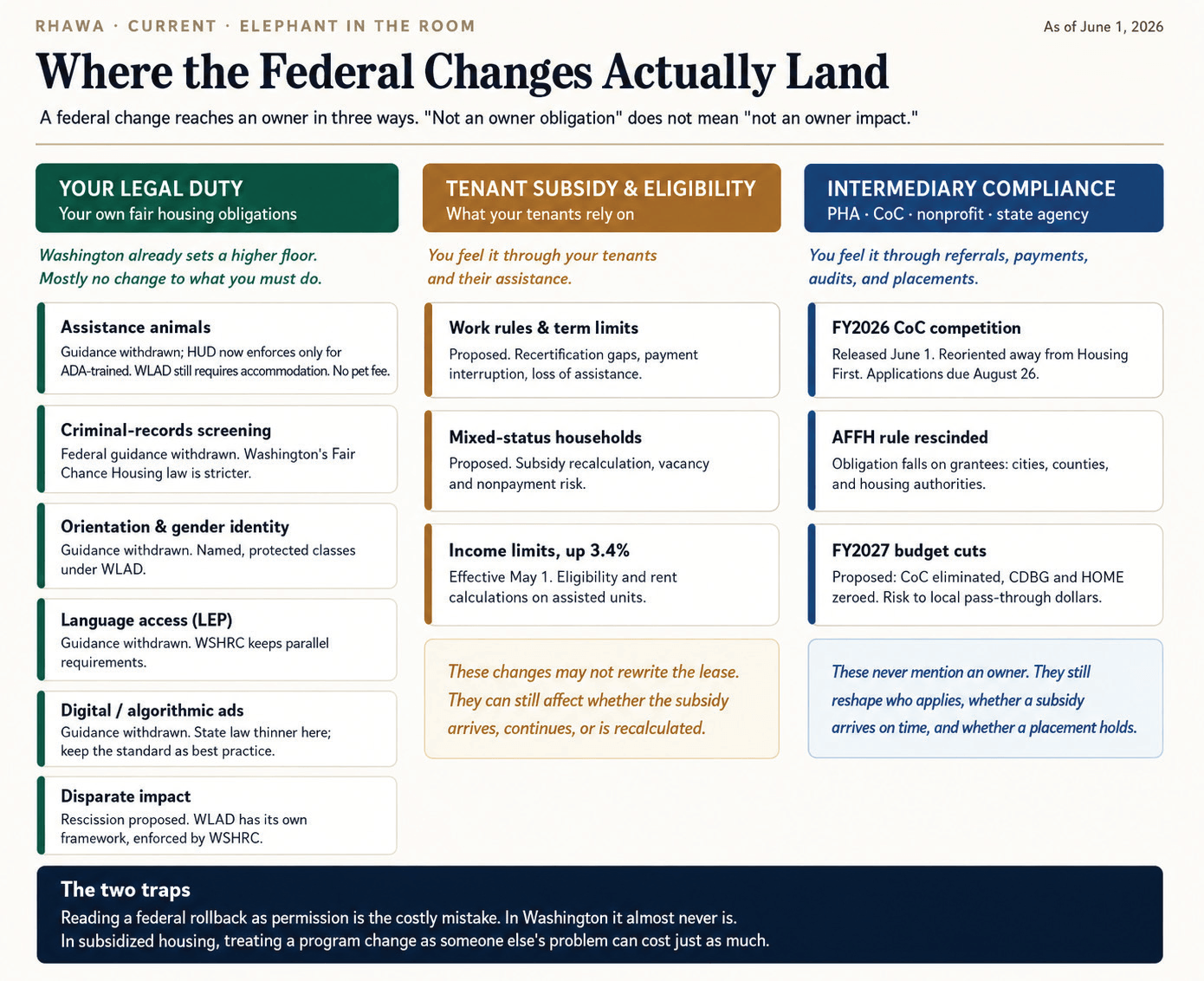
The Elephant in the Room
None of these forces, alone, reshapes an industry. A supply bill is welcome and slow. A guidance withdrawal is a venue change in a state that already protects the tenant. A funding competition rewrites its priorities. Taken one at a time, each is manageable, which is exactly why each tends to get discussed one at a time.
The mammoth is the convergence. The federal regulatory layer is thinning from the top in the same fiscal year that the rules for federal housing dollars are being rewritten, and the legislative response is still unsettled. The forces share a timeline. The federal fiscal year begins on October 1. Washington's state fiscal year and most local program years begin July 1. The homelessness competition closes on August 26 and pays out in December. The decisions are being made now for a window that opens in months.
And here is the catch particular to operating here. Federal deregulation is not Washington deregulation. The good ideas in the supply bill and in HUD's own playbook only become housing if the Legislature and our city halls choose to use them, and those bodies answer to voters. Federal policy can open a door. It cannot make Washington walk through it.
So carry three things out of all this. Do not mistake federal deregulation for Washington deregulation, because state and local law still set the floor here, and it sits higher. Do not mistake a federal supply bill for local housing production, because the units only appear if Olympia and our city halls let them pencil out. And do not assume federal program changes stay inside the nonprofit system, the housing authority, or the state agency. When subsidy rules, funding priorities, or eligibility standards shift, the pressure lands in the rental market, on the people who own and manage the units, and on the people receiving the subsidy assistance.
The mammoths did not die from one blow. The lesson is not that any single change is fatal. It is that when enough pressure arrives at once, even the largest animals can run out of room. That is when change becomes mammoth.