
Mission Failure

The King County Regional Homelessness Authority, or KCRHA, received $533.9 million between mid-2021 and July 2025. This has come to light due to a recent audit, in which the KCRHA could not, in the auditors' own words, “reliably trace where most of it went”, and is now being dismantled.
During the same window, Seattle and King County passed eleven local rental-housing measures justified by some combination of homelessness, displacement, housing instability, or affordability rhetoric. The agency is being dissolved on the evidence that the premise of pooled resources and unified funding streams failed.
But this was just one side of the coin for homelessness prevention and intervention. The other side of the holistic approach was the legislative side. And while the funding schemes are now, under intense internal and external scrutiny, forced to recall their efforts and start over, however the ordinances and legislation are not under those same calls.
That asymmetry is this article.
The Premise
For nearly a decade, Seattle and King County built a regulatory framework on a simple argument: eviction leads to displacement, displacement leads to homelessness, therefore restricting the legal tools available to housing providers prevents homelessness. Many of us recall the “eviction causes homelessness” catch phrase from that time period. For those who don’t it appears, repeatedly, in the legislative findings of the ordinances themselves.
Some ordinances invoked homelessness directly. Others used adjacent language about housing stability, eviction-prevention, or anti-displacement. Together, they formed the same policy frame: housing providers as the front line of homelessness prevention.
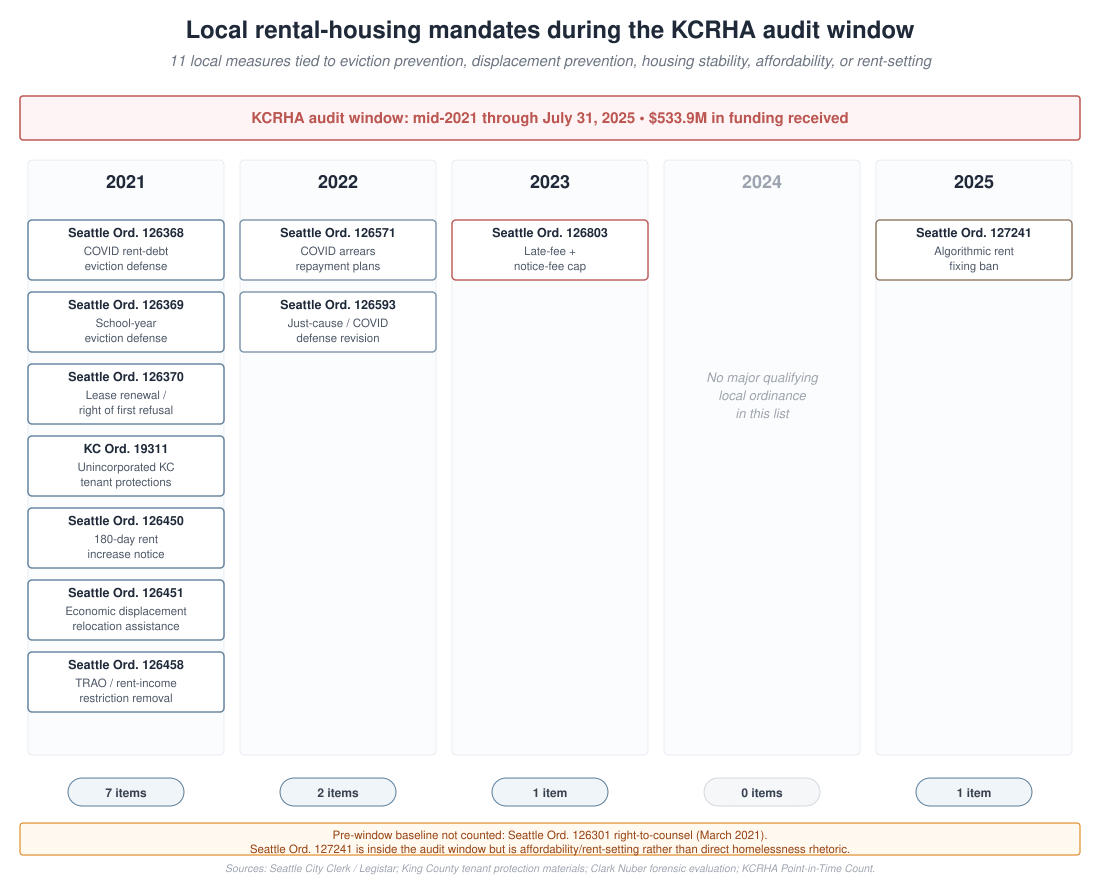
The legislative record is plain. The question is what the public system on the receiving end of all that prevention rhetoric actually looked like.
The Receiving System
KCRHA was formed in December 2019 through an interlocal agreement between the City of Seattle and King County. It became operational in mid-2021. This was the same start line as the regulatory wave above. From inception through July 2025, it received $533.9 million in funding from all sources. Its mission was to operate the regional homelessness support system throughout King County.
In April 2026, Clark Nuber P.S. completed a forensic evaluation of the agency on behalf of the City and County. The findings are public.
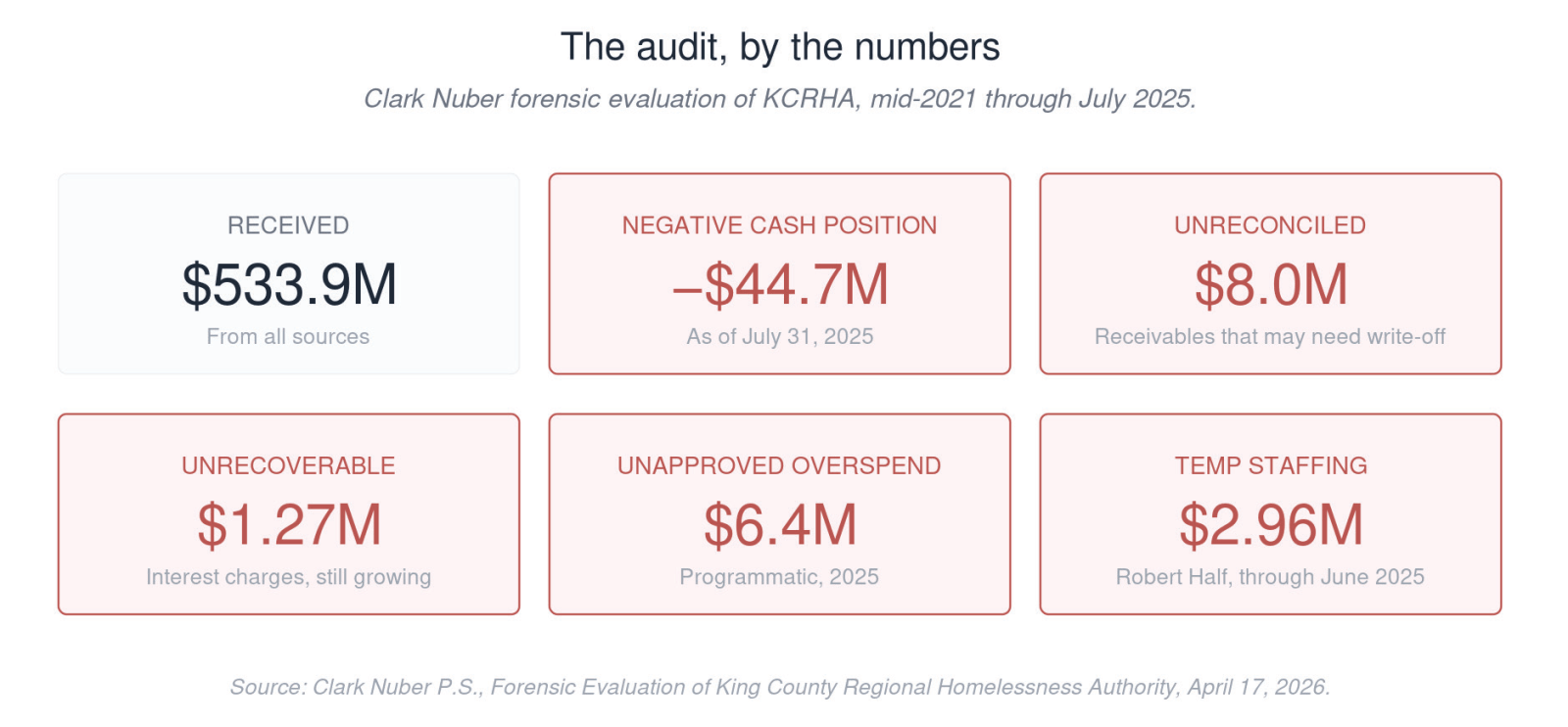
The most important finding is structural. The auditors stated that KCRHA's accounting records prior to late 2024 were not functionally traceable or reconcilable because of extensive batch journal entry accounting and the absence of an accounts receivable module. Substantial rework would be required to follow the money. Traceability limitations remained as of July 31, 2025.
In plain language: hundreds of millions of dollars moved through the system, and the records were not maintained in a way that allowed the auditors to follow them without rebuilding the books.
KCRHA had not formally adopted the comprehensive internal control framework the report identifies as required under federal Uniform Guidance. Of 24 sampled disbursements, 79% were approved by individuals whose roles did not match the documented approval authority. Of 14 sampled P-Card transactions, 100% contained internal control compliance exceptions. The P-Card policy itself remained in draft from 2021. Five years unfinalized.
The auditors did not identify specific evidence of large-scale fraud. That sentence is not a clean bill of health. The same report states that, because of internal control limitations, the risk of fraud, waste, and abuse remains, with elevated risk in cash-equivalent areas.
In plain English, the tools to prevent and detect fraud don't exist, and therefore none has been currently found.
The Mission NOT accomplished:
The audit answers one question: whether the money was well managed. It does not answer the question that follows — whether the mission was accomplished.
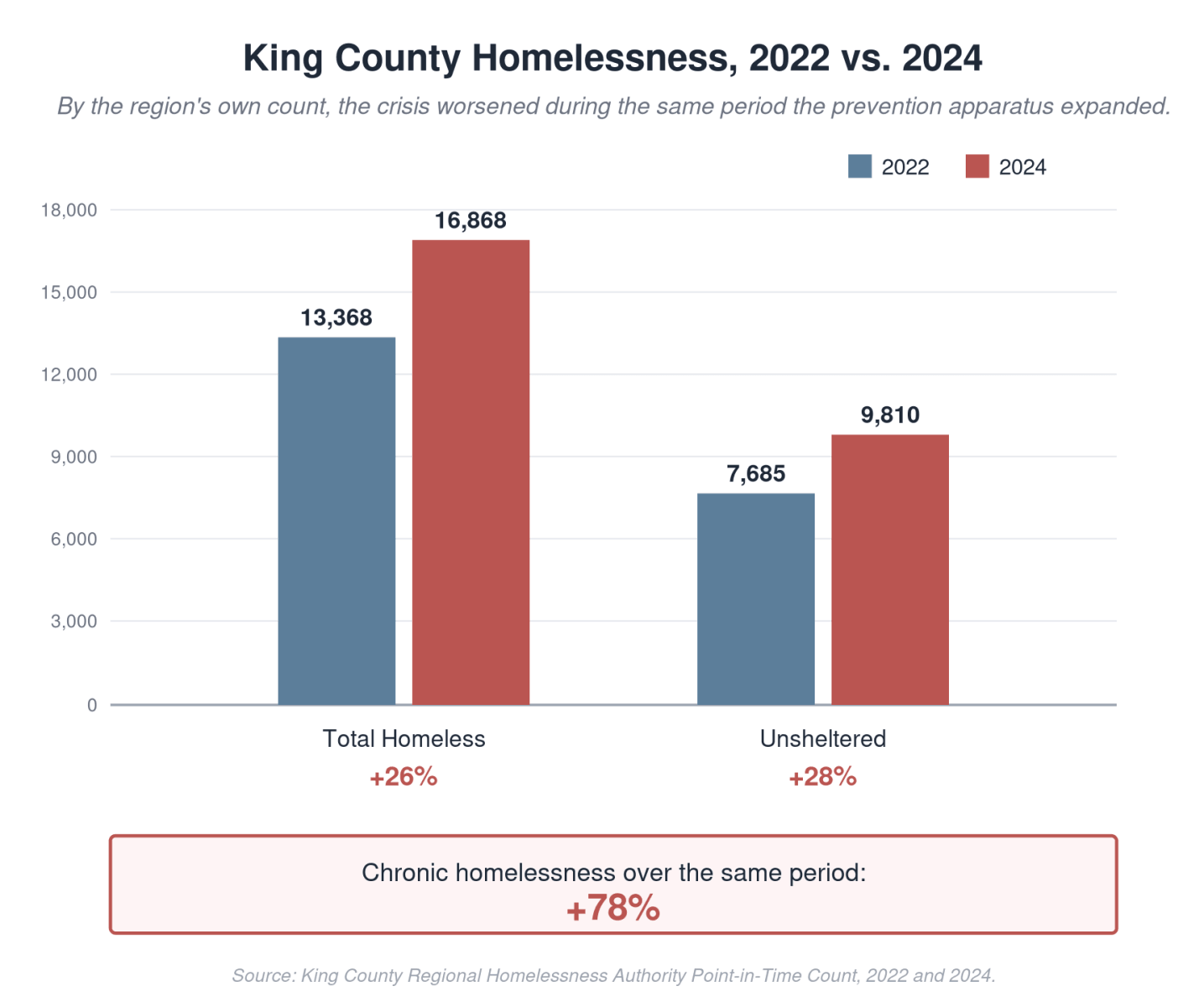 For that, the most visible public outcome indicator is the King County Point-in-Time count. Between 2022 and 2024, using comparable KCRHA methodology, total homelessness in King County rose from 13,368 to 16,868 — a 26% increase. Unsheltered homelessness rose from 7,685 to 9,810. KCRHA's own reporting documents a 78% increase in chronic homelessness over the same period.
During the same period that public money flowed into the regional homelessness system, and during the same period local governments imposed new obligations on housing providers in the name of homelessness prevention, the region's visible crisis worsened sharply. The prevention premise did not deliver the outcome its rhetoric promised.
The Asymmetry
Rental housing providers operate under a regime of procedural exactitude. A defective notice creates legal exposure. A missed deadline can forfeit a remedy. A documentation error can derail an otherwise valid process. That standard exists because housing matters and residents' homes are at stake.
The Clark Nuber evaluation shows that the public homelessness authority, entrusted with hundreds of millions of dollars to address homelessness, was not held to a comparable standard. Records were not functionally traceable. Internal controls were not in place. The 2024 internal financial statements differed from the audited financials by approximately $1.3 million.
Can you imagine if KCRHA were held to a standard of accountability that was even close to the standard of accountability private housing providers are held to? A private housing provider can be penalized for failing to use the proper font size on a notice, meanwhile KCRHA spent 533.4 million, fails the most basic of audits and somehow increased homelessness?!
The Addison
The asymmetry is not theoretical. It has a Seattle address.
The Addison on Fourth is a ten-story affordable housing building on the edge of Chinatown-International District. In 2012, Goodman Real Estate purchased it for $12.5 million and invested another $26.5 million in renovation. The building qualified for the federal Low-Income Housing Tax Credit program, meaning the property is legally required to operate as affordable housing for decades.
From 2015 through 2018, the Addison ran the way affordable housing is supposed to. Rent collections averaged 93% of gross potential rent. Vacancy was low. Evictions were rare. Long-term residents knew each other.
Then Seattle began layering ordinances. Six measures between 2018 and 2022 - Fair Chance Housing, the Roommate Ordinance, the Winter Eviction Ban, the COVID-19 moratorium, the 180-day notice requirement, and EDRA fundamentally changed what it meant to operate the building.
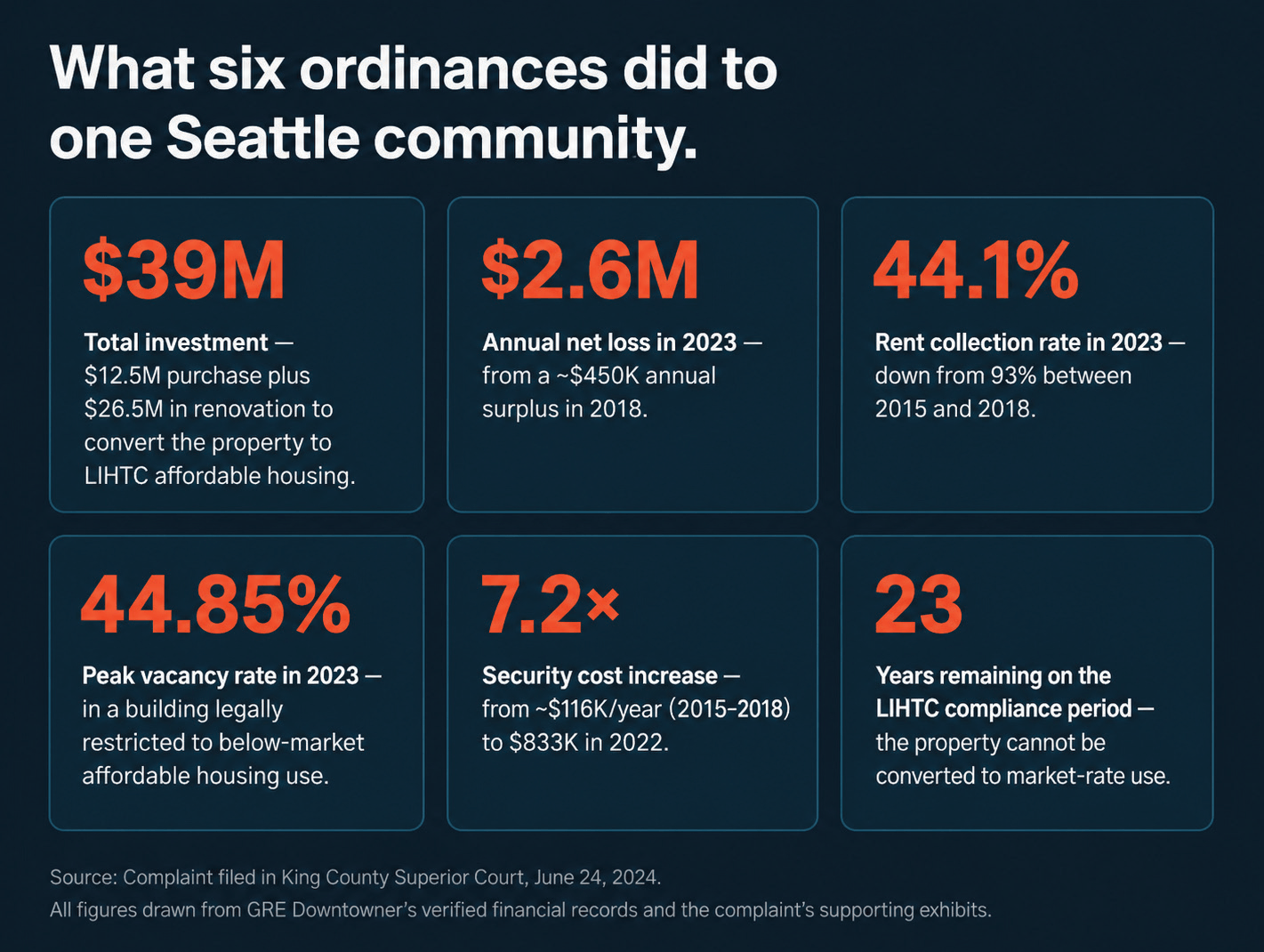
By 2023, the building's operating reality had collapsed across every dimension at once.
As of November 2023, GRE Downtowner is in default on its mortgage. In June 2024, GRE sued the City of Seattle, alleging that the cumulative effect of the six ordinances amounted to a constitutional taking. The Superior Court dismissed the case in February 2025. GRE appealed. The case is now at the Washington Court of Appeals as GRE Downtowner LLC v. City of Seattle, COA No. 87886-7.
Counsel for GRE argued the six ordinances "operated together to destroy the value of the Addison." The City argued business losses do not convert routine regulation into a taking. No ruling has been issued as of the date of this article’s draft.
GRE Downtowner is a RHAWA member. RHAWA has publicly supported the litigation since its filing. A city cannot preserve affordable housing by making affordable housing impossible to operate.
The Pending Dissolution
On April 28, 2026 — eleven days after the Clark Nuber audit was published — King County Councilmember Rod Dembowski and Seattle City Councilmember Maritza Rivera introduced a joint resolution to dissolve KCRHA over a 90-to-120-day winddown.
Dembowski's framing was direct: "The problem of unsheltered people has gotten twice as bad in the six years they've been around. So it's not working. And I think when something isn't working, you're in a hole. Stop digging."
A separate proposed ordinance fast-tracks the creation of a new King County Inspector General office with subpoena power and the authority to recover misspent public funds. The IG office is expected to be operational within 45 days.
It is also worth naming what the regional authority structure was always good at. KCRHA was chaired by elected officials but not directly run by them — close enough to take credit, far enough to assign blame. The audit did not catch the elected officials who designed and funded the system. It caught the agency built to absorb the consequences.
The political response to the audit, in other words, is straightforward: the agency that managed the money has lost the confidence of the elected officials who funded it. The political response to the ordinances passed under the same prevention premise is silence.
What's Being Reconsidered, and What Isn't
Both halves of Seattle and King County's homelessness strategy were sold under the same premise: the prevention frame would reduce homelessness if the public system had the resources and housing providers absorbed the regulatory burden. The audit and the Point-in-Time count have now tested both halves.
The agency is being dissolved.
The ordinances are not currently under review.
This is the asymmetry RHAWA members should be paying attention to. The same elected bodies that are willing to look at the audit and conclude the agency cannot continue in its current form have not extended that review to the ordinances enacted alongside it. The regulatory stack that hit the Addison, the rules that converted ordinary housing operations into procedural minefields, the mandates passed in the name of preventing exactly the deterioration the Point-in-Time count documents. None of those are on any agenda for reconsideration.
Either there is a holistic strategy being employed here, or there is not. If the agency failed because the prevention premise was wrong, the ordinances passed under the same premise deserve the same scrutiny. If the ordinances are sound policy on their own merits, the elected officials who passed them should defend them on those merits, not on a homelessness-prevention rationale the audit and the PIT count have refuted.
What we have instead is a one-sided unwinding. The public side gets dismantled. The private side keeps the rules.
Time for a Reboot
Housing providers have done their part. They have absorbed the mandates, complied with the timelines, carried the procedural risk, and remained the practical backstop for a public crisis they did not create, even when it has led to ruin for their ability to operate and invest in their community. The accountability they have been asked to embody is not, by any honest accounting, the accountability the public system has demonstrated in return.
KCRHA took years to build. The dissolution motion arrived eleven days after the audit was published. That speed itself is informative. It suggests the political read on this audit was settled before the audit landed. Bad audits have a way of resolving institutional ambiguity quickly when the evidence has been accumulating for a while.
But if the prevention premise has failed badly enough to dissolve the agency built on it, it has failed badly enough to revisit the ordinances built on it.
It’s time that policy makers admit what is plainly obvious to anyone paying attention. The legislative and funding solutions have failed. Eviction didn’t cause homelessness but it sure looks like KCHRA did. Evictions didn’t cause homelessness but it sure looks like the layering of regulations did.