Spokane Complex Fire: Resources for Housing Providers, Residents, and Neighbors
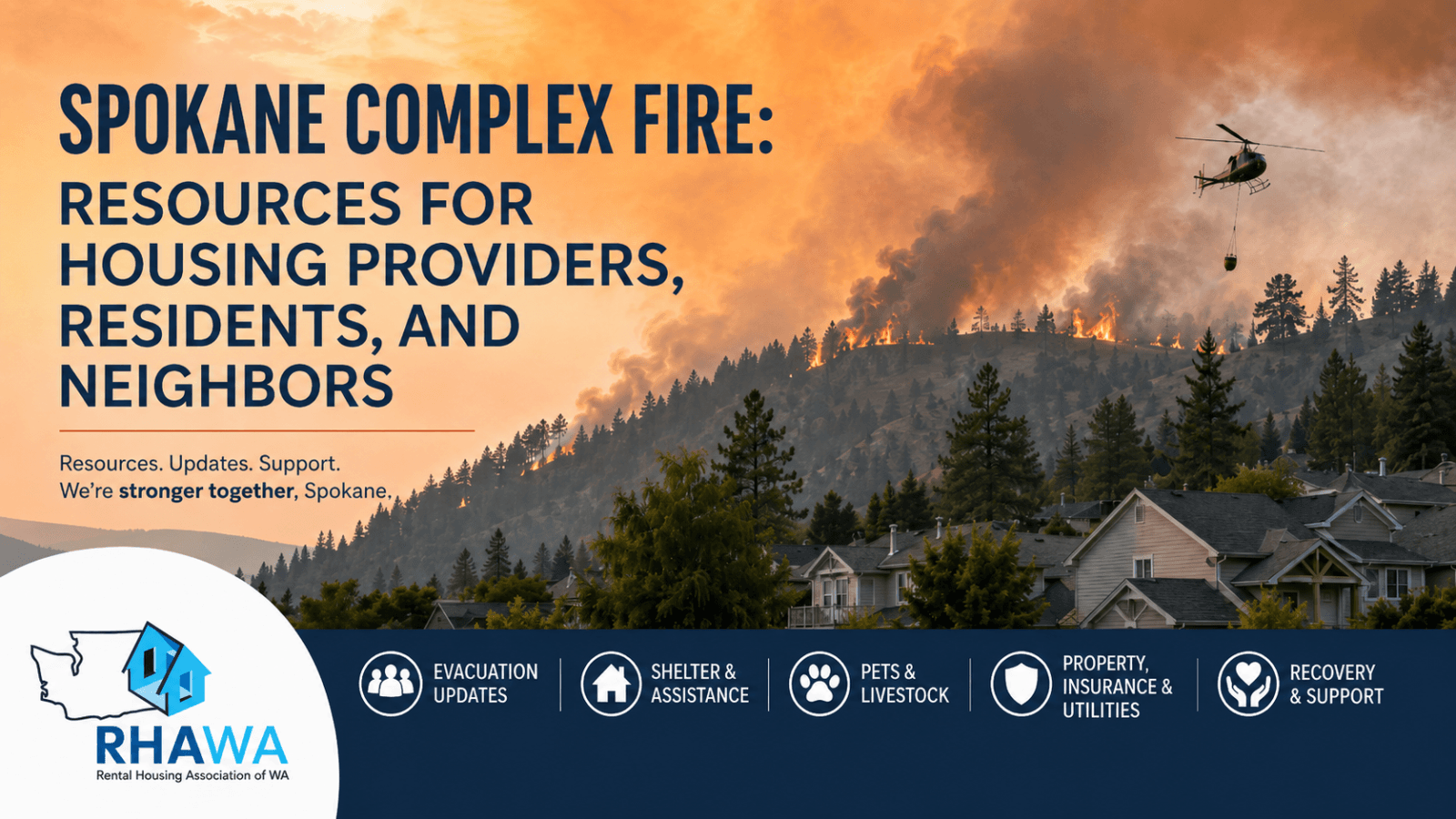
Spokane Complex Fire: Resources for Housing Providers, Residents, and Neighbors
By Daniel Klemme
To the Spokane community: RHAWA extends our deepest condolences, thoughts, and prayers to all those affected by the Spokane Complex Fire. Our region is facing one of the hardest moments in its history, and our hearts are with every family, neighbor, and business enduring this loss.
Last verified Monday, August 3, 2026. Evacuation zones, shelter locations, and assistance programs are changing quickly. Always rely on the official sources linked below for the latest information rather than screenshots or social media reposts.
The Spokane Complex Fire, made up of the Old Trails, Fairview, and Autumn Lane fires, has forced roughly 65,000 people from their homes and destroyed hundreds of structures across north and northwest Spokane. Governor Ferguson has declared a statewide wildfire emergency, and a statewide ban on most outdoor burning is in effect through September 30.
What matters most right now is the safety of our families, friends, neighbors, and community. If you are in immediate danger, call 911. If officials tell you to leave, leave. Property can be rebuilt. People cannot be replaced.
What comes after the crisis will take much longer. Thousands of people, owners and renters alike, are waiting to learn whether they still have homes to return to. Rebuilding will be measured in months and years, not days. This post gathers the resources people need right now, and the information they will need for the recovery ahead. Whether you own your home, rent it, or provide rental housing to others, it is for you. RHAWA members: your obligations and responsibilities after a fire are covered in three sections below: Guidance for rental property owners and managers, If a rental home was destroyed or made uninhabitable, and Additional notes for property owners.
A word to our members and neighbors. Many of our members have lost their homes. Some have lost rental units. But many have lost their primary residences: the places where they raised their kids, celebrated holidays, and planned to retire. There are no words that make that easier. We want to be honest about what this post is and is not. Conditions are changing by the hour, and the people best positioned to keep you current are the emergency management agencies tied directly into the response. That is exactly why we have gathered the trusted sources below: so you can connect to the people who can update you in real time. We will do our best to keep this post current and share updates on our social media channels as things change, but the goal is to point you to those direct sources, not to be your sole point of contact. Above all, we wanted to say something, and to pass this along, as our way of helping our members and the wider community through a hard and uncertain time.
RHAWA would also like to thank our first responders: police officers and sheriff's deputies, the National Guard, structural and wildland firefighters, air crews, dozer and heavy equipment operators, and the personnel and resources committed by our local, state, and now federal government. Thank you for all of the work and sacrifice to save our community.
Evacuation orders and official updates
- SREC Evacuation Address Lookup Map: Enter the exact address of your home and each rental property to check its current evacuation level. The map is updated frequently. Do not rely on yesterday's information.
- Spokane County Complex Fire Updates: The county's central resource page, with current shelter information, animal services, community services, court closures, and emergency announcements. See also the county's State of Emergency services update page.
- Spokane County Emergency Management: Evacuation levels explained, go-bag checklists, pet preparedness, and emergency preparedness information translated into Arabic, Chinese, Dari, Marshallese, Russian, Spanish, Ukrainian, and Vietnamese.
- Spokane 911 / Spokane Regional Emergency Communications: The regional 911 agency behind the evacuation map. Call 911 only for emergencies; use the map and county pages for status updates.
- Alert Spokane: Register your phone number and addresses to receive emergency warnings. Housing providers and managers should encourage residents to register separately for their own addresses.
- Washington DNR Wildfire Dashboard: Statewide information on active fires, acreage, and incident status. Evacuation instructions should still come from Spokane County and SREC.
Shelter and immediate assistance
- Spokane Convention Center, 334 W. Spokane Falls Blvd., is operating as the primary emergency evacuation shelter. Parking is free and pets are welcome.
- American Red Cross: Use the shelter finder, the Red Cross Emergency App, or call 1-800-733-2767. You may visit a shelter for meals, phone charging, health services, and supplies without staying overnight. Identification is not required.
- Stevens County (Autumn Lane Fire): A Red Cross shelter is open at Jenkins High School, 702 E. Lincoln Ave., Chewelah, for evacuees in south Stevens County. Kettle Falls Middle School is also open, and small animals are welcome at both locations.
- Washington 211: Dial 211 for help locating temporary housing, food, transportation, health services, utility assistance, and other disaster resources.
- YMCA shower access: Spokane-area YMCA locations are open Monday through Friday, 8:00 a.m. to 5:00 p.m., for anyone affected by the fires to use showers.
- Emergency childcare: Spokane Public Schools is offering a free drop-in camp for children ages four and older, Monday through Friday, 11:00 a.m. to 3:00 p.m., at Shadle Park High School.
- Food assistance: Second Harvest Inland Northwest coordinates food banks across the region and can direct you to the nearest distribution site.
Pets, livestock, and lost animals
- Spokane County Fair and Expo Center, 404 N. Havana Street, is accepting evacuated RVs, livestock, pets, and horses. Use the Red Gate off Broadway Avenue and bring carriers for dogs and cats.
- Stevens County large animals: Stevens County Emergency Management is directing large animals to the Stevens County Fairgrounds, Arden Rodeo Grounds, and Springdale Rodeo Grounds.
- SCRAPS emergency line: 509-477-2533 for animals with urgent medical needs and animal rescue coordination.
- SpokAnimal Guardian Angel Program: Temporary help for people unable to care for their animals because of the fire. Call 509-534-8133.
- Lost and found animals: Spokane County's fire resource page links to the public spreadsheet maintained for animals found or missing during the fires.
Smoke and indoor air quality
- Spokane Regional Clean Air Agency: Current AQI readings and forecasts. As of Monday morning, an air quality alert remained in effect, with conditions in the unhealthy to very unhealthy range.
- SmokeReady Spokane, linked from the Clean Air Agency's current conditions page, covers filtration, creating a cleaner-air room, masks, and protecting children and older adults. Housing providers with vacant units in smoke-affected areas should also review HVAC filter guidance before turnover work.
Insurance, financial help, and property damage
- Washington Office of the Insurance Commissioner: Wildfire claim guidance and help resolving problems with your insurance company. The Consumer Hotline is 800-562-6900, weekdays 8:30 a.m. to 4:30 p.m. The Commissioner has issued an emergency insurance order effective August 3 through September 30, 2026, providing relief for people affected by the wildfires. If you are struggling to pay premiums or your insurer is unresponsive, call the hotline and reference the emergency order.
- Contact your insurer immediately, even before you know the full extent of damage. Ask specifically about building coverage, lost rental income, debris removal, code upgrade coverage, additional living expenses, and emergency mitigation costs. Keep a log of every call, adjuster name, and claim number.
- Renters: If you rent your home, contact your renters insurance carrier about personal property coverage and additional living expenses, which can help pay for temporary housing.
- Mortgage relief: If your home or rental property is damaged, call your mortgage servicer and ask about disaster forbearance options before missing a payment.
- Property tax relief for destroyed property: Washington law allows a reduction in assessed value for property destroyed by fire. Contact the Spokane County Assessor about filing a destroyed property claim.
- Federal assistance: FEMA has authorized Fire Management Assistance Grants for the Spokane Complex Fire. These grants reimburse firefighting costs and do not provide direct payments to individual home or business owners. If a federal major disaster declaration with Individual Assistance is approved later, we will update this post with application information.
- After the Fire Washington: Post-Fire Recovery Practices: A statewide resource built from Washington's past wildfire recoveries, covering debris removal, rebuilding homes, insurance after a fire, erosion control, burned tree removal, and disaster case management, with guides for homeowners, agricultural landowners, and forest landowners.
Utilities
- Avista: Report or check outages through Avista's outage center. Residential customers may call 800-227-9187; business customers may call 800-936-6629. Do not attempt to reconnect service or relight appliances in a fire-damaged structure until the utility and officials confirm it is safe.
Watch out for scams, price gouging, and contractor fraud
After every major fire, bad actors follow. Protect yourself and your residents:
- Price gouging: The Washington Attorney General's Office pursues exploitative price increases on essential goods and services, including shelter, under the Consumer Protection Act. If you see it, photograph it and file a complaint with the Attorney General or call 1-800-551-4636.
- Contractor fraud: Before hiring anyone for cleanup, repairs, or rebuilding, verify the contractor's registration with Washington Labor & Industries. Be wary of door-to-door solicitors, demands for large cash deposits, and pressure to sign on the spot. Get written bids and never sign over an insurance check to a contractor.
- Charity scams: Give through established organizations. See the donation section below.
Guidance for rental property owners and managers
Housing providers are dealing with two layers of this disaster at once: their own families and homes, and the homes they provide to others. A few immediate steps:
- Check every property against the SREC evacuation map, including properties outside the immediate fire area that may be affected by smoke or power loss.
- Establish contact with each resident. Confirm they are safe, share the shelter and assistance resources in this post, and document that outreach.
- Preserve all communications. Keep texts, emails, voicemails, and notes from every conversation with residents, insurers, and officials.
- Do not enter an evacuation zone until officials authorize reentry. Once access is allowed, photograph and video the property thoroughly before any cleanup or demolition begins.
- Consult an attorney before making decisions about a damaged unit. Fire-damaged tenancies raise complicated questions, and the right time to think them through is before acting, not after. The general rules in this post are a starting point, not legal advice for your situation. For specific questions, talk with an attorney experienced in residential tenancy law. For now, focus on safety and documentation.
Members can also reach the RHAWA Spokane office at 509-535-1018, Monday through Friday, 9:00 a.m. to 5:00 p.m. (Contact page.)
If a rental home was destroyed or made uninhabitable
For homes that burned or that officials say cannot be occupied, a few basics apply to both housing providers and residents:
- Structural restoration is the housing provider's responsibility. Repairing the building, walls, and built-in systems to bring the unit back to a safe, livable condition falls to the owner, unless the resident intentionally or negligently caused the fire.
- Rent stops for time the home cannot be lived in. If the unit is destroyed or tagged unsafe or uninhabitable by officials, the resident does not owe rent for that period, and rent already paid for it should be refunded pro rata. For example, if rent was paid for all of August and the home burned on August 1, the unused portion of that month belongs to the resident.
- The resident may end the tenancy immediately. Washington law gives residents the right to terminate when the home is uninhabitable, and in most total-loss situations both parties will treat the tenancy as ended.
- Security deposits must still be accounted for and returned within 30 days of the tenancy ending. When the resident is not at fault for the fire, the damage cannot be deducted from the deposit. In most fire-loss situations, that means the full deposit comes back.
- Personal belongings are covered by renters insurance, not the owner. The housing provider is generally not responsible for replacing a resident's furniture, clothing, or other personal property. This is exactly what renters insurance exists for, and residents should contact their carrier as soon as possible.
- Negligence changes that. If a fire resulted from known safety hazards the housing provider failed to address, such as faulty wiring or non-working smoke detectors, the provider can be held liable for the resident's damaged belongings.
- Situations involving unpaid rent, pending notices, or partial damage are fact specific. This post covers the general rules. For a specific situation, consult an attorney experienced in residential tenancy law before making decisions.
Additional notes for property owners
- Insurance: As covered above, contact your insurance company as soon as possible to report the loss, and keep a log of every call, adjuster name, and claim number.
- Moving into your own rental unit: If your primary residence was lost and you plan to move into one of your rental units, Washington law allows an owner who will occupy the unit as their principal residence to end the tenancy with at least 90 days written notice. RHAWA members should use the End of Tenancy Notice form in their forms library, and having an attorney review the notice before serving it is money well spent. The resident receiving that notice will need time to plan as well, so early and honest communication helps everyone.
- Rehousing displaced residents: Housing providers are not obligated to rehouse a resident who has lost their home. The most helpful thing an owner can do is share the resources gathered in this post. Providers with vacant units who choose to make them available should remember that emergency price restrictions on essential goods and services include shelter.
How to help
- Innovia Foundation Spokane Complex Wildfire Response Fund: Supports vetted nonprofit and community organizations providing immediate and long-term relief. This fund does not make direct payments to individuals.
- City of Spokane donation and volunteer portal: The City has launched a central portal to organize donations and volunteers. Check spokanecity.org for the current link. Officials are asking people not to self-deploy or drop off unsolicited goods at shelters.
The road ahead
The fires will be contained. The harder work comes after: reentry, damage assessments, insurance claims, debris removal, permitting, and rebuilding. That process will take a long time, and it will test the patience of everyone involved. Owners and renters are in this together, and most of the disputes that arise after a disaster come from confusion and stress rather than bad intent. Clear communication, good documentation, and a willingness to ask before acting will carry both sides through it.
RHAWA will continue monitoring the response and recovery, and will follow up with members on the housing and tenancy issues that come with fire loss once the immediate emergency has stabilized. If you have questions about a specific property or tenancy in the meantime, consult an attorney experienced in residential tenancy law.