
What Spokane’s Cooling Ordinance Means for Housing Providers

The Spokane City Council is considering an ordinance, the proposed Renters’ Right to Cooling (SMC 10.57.175), that would require landlords to maintain bedroom temperatures at or below 80°F in every rental unit in the city by January 1, 2031, with non-compliance classified under state law as “imminently hazardous to life.” That is the same legal category as gas leaks and structural collapse. The first reading is scheduled for May 18. By the time this issue of Current reaches members, that hearing may or may not have happened, and the ordinance may have been passed, deferred, or amended beyond recognition.
What members across the state should understand is what this ordinance would actually do, what RHAWA and our coalition partners have done in response, and why we chose to lead.
What Is Actually Being Proposed
The ordinance is not an update to existing law. It would repeal Spokane’s existing portable cooling ordinance, which the same Council passed unanimously in 2024, and replace it with a far broader retrofit mandate. The compliance obligation is per bedroom, not per unit. Spokane has roughly 41,000 renter-occupied housing units; at a median of two bedrooms each, the proposed standard covers more than 80,000 individual bedrooms.
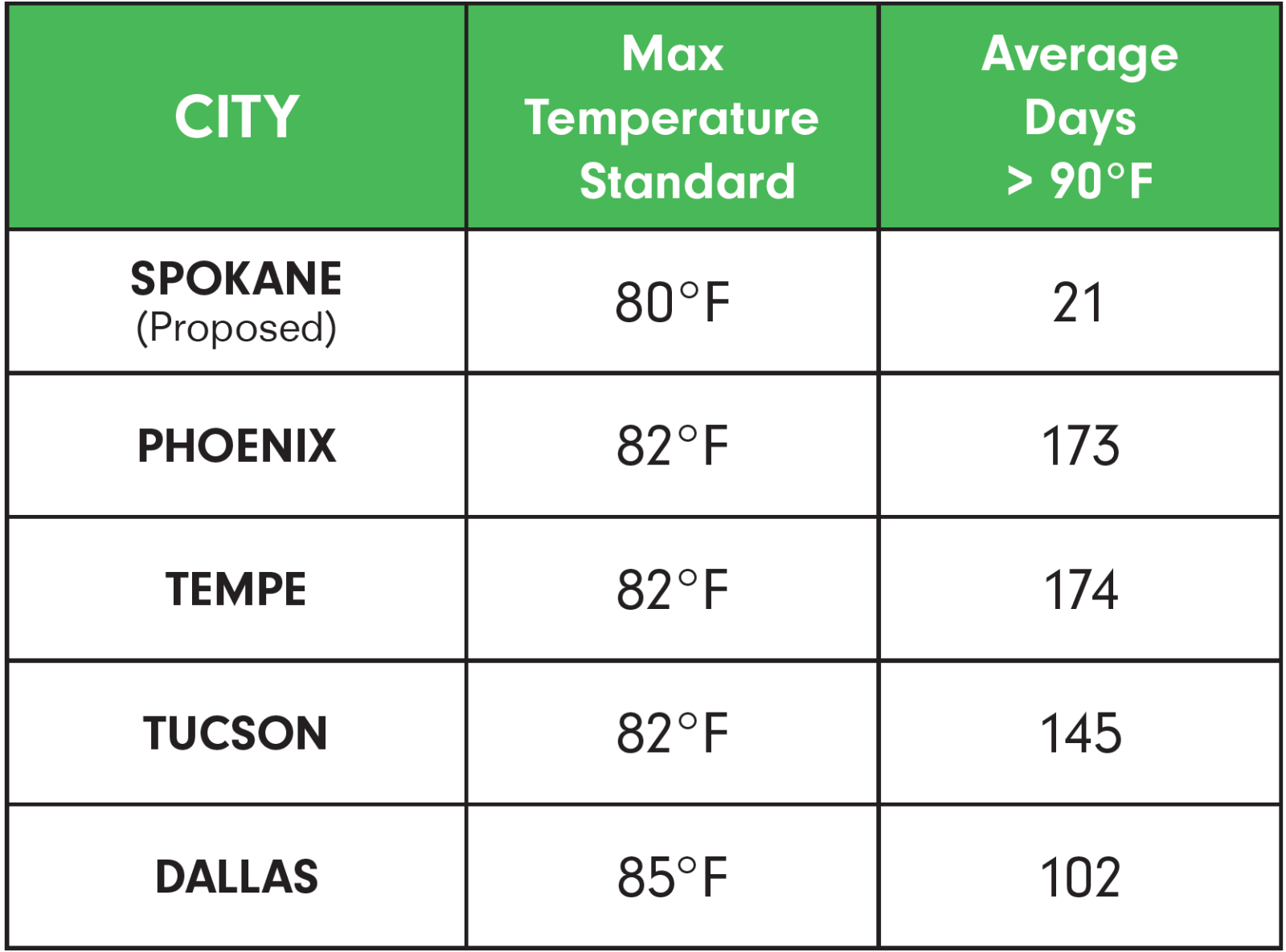
The 80°F standard would be stricter than major cities in the desert Southwest. Every jurisdiction cited in the draft ordinance’s supporting materials sits in the desert Southwest, the Gulf Coast, or applies only to vulnerable populations in institutional settings. No Pacific Northwest city appears anywhere on the list.
Meanwhile, ESSB 6200, the statewide right to portable cooling, passed both chambers of the Washington Legislature with strong bipartisan support (65-28 in the House, 37-12 in the Senate) and was signed by the Governor in March. It takes effect June 11. It guarantees every renter in Washington the right to install and use a portable cooling device of their choosing, without landlord permission and without retrofit. The state framework was built to be operational well before peak summer heat, and it addresses the underlying access problem at zero capital cost to housing providers and zero passthrough cost to tenants.
The proposed ordinance would override that.
What Have We Done?
On April 9, RHAWA delivered a coalition letter to the Spokane City Council co-signed by ten Spokane housing and real estate organizations. The signatories include builders, realtors, multifamily operators, property managers, brokerages, and downtown business leaders, collectively representing tens of thousands of rental units in the city.
The coalition advocacy included:
- Asking the Council to allow ESSB 6200 to take effect before layering a separate local mandate.
- Offering a constructive alternative: a city-funded subsidy to help residents purchase portable cooling devices.
- Delivering comprehensive economic and technical analysis, including climate comparison data, housing stock breakdowns, compliance cost estimates by retrofit scenario, and a structural review of enforcement provisions.
- Leveraging sector-specific expertise from builders, realtors, and tradespeople.
Why We Chose to Lead
RHAWA’s leadership knows when to lead, when to fight from a supporting position, and when to get out of the way. Each posture is appropriate in different circumstances, and using the wrong one is its own kind of failure.
On the Spokane cooling ordinance, we chose to lead. The reason is straightforward: a substantial number of our Spokane members would be directly and materially harmed by this ordinance if it passed. Retrofit costs that older buildings cannot economically absorb. New private rights of action and licensure exposure. Pressure that would push marginal properties out of the rental market entirely. When the impact on members is that direct, leading is the responsibility, not the option.
We are also grateful to the partners across the industry who joined the coalition letter, contributed expertise, and helped shape the response. Coalition work is collaborative by definition. RHAWA can lead and still owe thanks to every organization that put a name on the line.
The Lesson for All Members
The case against this ordinance is specific to Spokane, but the pattern repeats. Local habitability mandates layered on top of state law tend to produce three predictable harms:
- They create compliance conflicts between codes.
- They impose retrofits on buildings that cannot economically absorb them.
- They accelerate the loss of the very units policymakers say they want to preserve.
Local ordinances can do real damage even when they are well-intentioned. Sometimes especially when they are well-intentioned. This is why RHAWA fights at the state level and the local level. A bipartisan state law can still be undermined by a single city council in a single jurisdiction, and the cost of that undermining falls on the housing providers and the tenants in that jurisdiction.
It is genuinely disappointing to see an issue resurface on something that members of both parties, working together, thought was settled at the state level. ESSB 6200 was the product of careful legislative work. It deserves the chance to do its job.
What Comes Next
The first reading is expected on May 18, but the real outcome is uncertain. The ordinance may be deferred, which we believe best serves Spokane residents and housing providers alike. It may be significantly amended. It may pass in something close to its current form. We do not know which.
What we do know is that the work continues regardless. ESSB 6200 will take effect on June 11. Other cities will watch what Spokane does. RHAWA and our coalition partners will continue to engage on the next ordinance, the next session, the next jurisdiction where local layering threatens the housing stock our members provide and our communities depend on.
No matter the outcome, we will not stop fighting.