
LOCAL RENTAL HOUSING REGULATION WATCH: November 2025
With the pace of local rental housing policy, it can often be difficult to keep up with what these regulations are and how they came to be. Luckily, RHAWA is your resource to learn about developments in rental housing policy and how to advocate for your business. We often see trends in local rental housing policy, and this year, there are two major issue areas that local city councils are attempting to address: Algorithmic rent pricing and “junk fees.” The approach to regulating these issues has varied, but this breakdown will give you a good idea of what these policies are shaping up to be and where they have been implemented and proposed.
Bans on Algorithmic Rent Pricing
Those who were deeply involved in the 2025 Legislative Session will remember that a bill banning algorithmic rent pricing failed to pass at the state level. While most of our members do not use the kinds of services this piece of legislation was targeting, RHAWA advocated to make sure our members would not be caught in the crossfire between the State and large corporations that utilize these kinds of services. Resulting from this bill failing, two local municipalities (Seattle and King County) have passed their own regulations on these services, and it is likely we will continue to see other versions in the near future.
The Seattle and King County versions of this policy were nearly identical, and it is crucial to take a moment and understand how this language impacts the use of these services.
In Seattle’s version of the ban, violations read as follows:
- It is a violation of this Chapter 7.34 for any landlord, in or affecting commerce, to contract with or otherwise exchange anything of value in return for the coordinating services of a service provider.
- It is a violation of this Chapter 7.34 for any service provider, in or affecting commerce, to provide coordinating services to two or more landlords.
- It is not a violation of this Chapter 7.34 for a landlord to use a system or software recordkeeping tool absent otherwise prohibited conduct under this Chapter 7.34.
The City Council further clarifies the definition of “coordinate” in order to ensure that this policy does not impact those who are simply using market data in order to price their units: "Coordinate" and "coordinating" mean a service provider’s: (1) collecting historical, anticipated, or contemporary prices, price changes, supply levels, occupancy rates, or lease or rental contract termination and renewal dates of residential dwelling units from two or more landlords, from private databases, or from public databases; and (2) analyzing or processing the information described in (1) through the use of a system or software that utilizes an algorithmic or other automated process to provide recommendations regarding rental prices, lease renewal terms, or occupancy levels to more than one landlord. “Coordinate” and “Coordinating” do not include publishing rental price estimates that:
- They are solely based on publicly available information.
- Are equally available to all members of the public; and
- Do not require a contract or agreement to obtain.
I understand this may be confusing to those who are not actively involved in analyzing the impact of rental regulations. But the way this policy is written is likely to have no impact on your business activities if you are not obtaining proprietary information from a paid service AND using that information in an automated service, which will give you rental pricing recommendations. Most members use data sources that contain publicly available information and simply price their rental units in accordance with comparable properties.
Similarly, King County passed its version of the bill, which includes the following language for violations:
- It is a violation of this chapter for two or more landlords to enter into an agreement, including but not limited to written, verbal, or implied from conduct, to establish rental prices, consistent with federal law.
- It is a violation of this chapter for a landlord, in or affecting commerce, to contract with or otherwise exchange anything of value in return for the coordinating services of a service provider.
- It is a violation of this chapter for a service provider, in or affecting commerce, to provide coordinating services to two or more landlords.
The definitions of "Coordinate" remain virtually the same as the Seattle version of this policy.
The most significant difference between the King County version of this policy and the Seattle version lies in the first line of violations, where King County added additional language regarding agreements between housing providers. This language was of great concern to RHAWA upon its initial presentation; however, the clarification that this language is “consistent with federal law” adds a layer of specificity to the language, which will not punish housing providers who are simply having a standard conversation about how they price their rental units. It must be a specific, coordinated effort to price rental units in an unfair way in order to be a violation of this language.
Both of these policies show how subtle differences in the language used in rental housing policy can make a significant impact on how policies impact housing providers in the real world. RHAWA is always working with local and state governments to ensure that unintended consequences are minimized for the small housing providers who are the lifeblood of our organization.
It is likely that we will see more local governments setting their sights on banning algorithmic rent pricing. RHAWA will continue to be there to make sure the language in these laws is specific in targeting those who are actually engaging in unfair or deceptive business practices, while allowing our members to continue operating their rental businesses the right way.
Prohibiting "Junk Fees"
Regular readers of CURRENT will remember that the City of Bellingham proposed a set of policies that would ban a variety of specific fees in their attempt to prevent “junk fees” in lease agreements. This proposal was eventually reshaped to be less restrictive, but Bellingham remains the most strict jurisdiction in the state in regard to “junk fees.” However, this concept of “junk fees” is still present in discussions around rental housing policy this year, and the City of Seattle may see regulations on this concept in the near future.
The Stay Housed Stay Healthy coalition has developed a list of potential “junk fee” regulations that greatly exceed nearly every standard set of policy proposals for excessive fees in the nation. While this list is not a policy proposal from the Seattle City Council, it is still crucial that we are observing and analyzing the ideas and proposals of other advocacy groups in the state. The SHSH list of potential “junk fee” regulations includes:
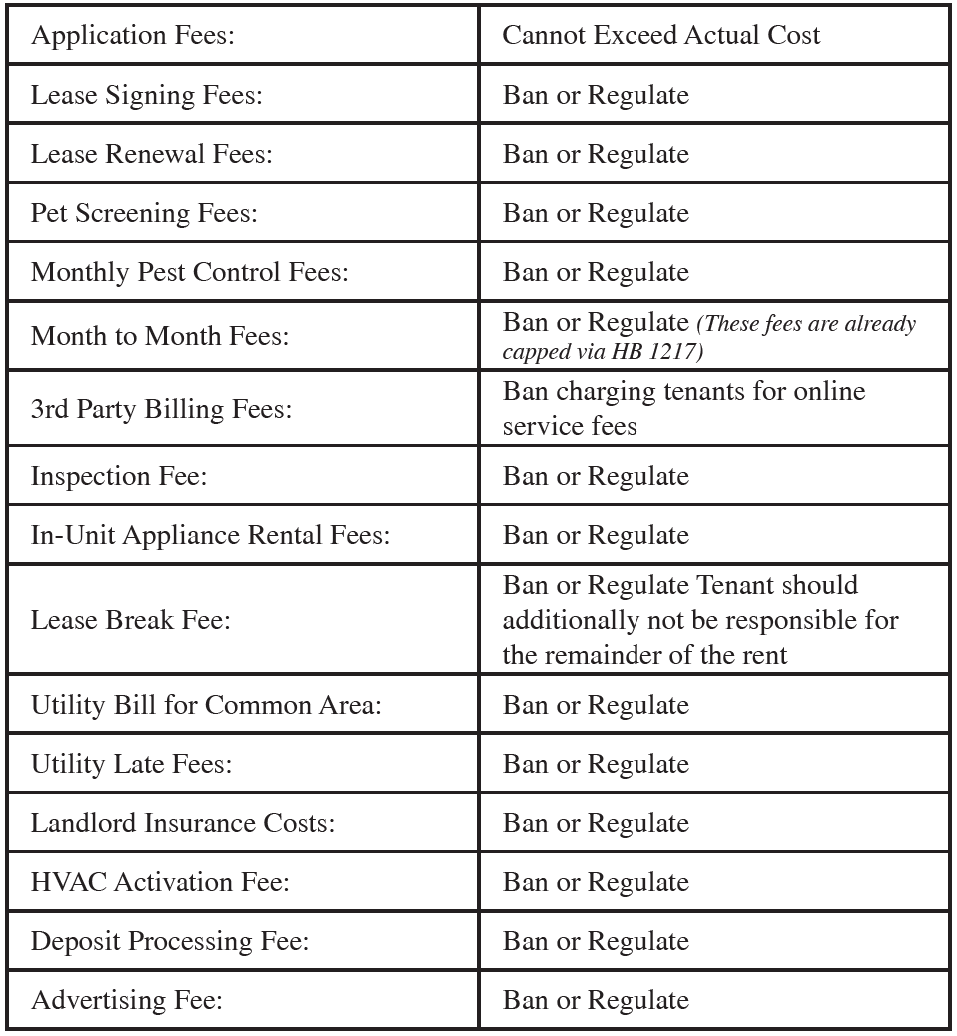
Recommendations that exceed any previously proposed or implemented policies are bolded.
This is obviously a concerning list due to the fact that this goes far beyond any kind of specific fee regulation the nation has ever seen. To give some perspective, the following is a list of the more common fees that have been regulated in other states.
Caps on Screening Fees:
- California: Capped at $30
- Colorado: Capped at Actual Cost
- Connecticut: Capped at $50
- Hawaii: Capped at Actual Cost
- Illinois: May not charge a fee if a portable report meets the required criteria
- Maine: Capped at Actual Cost
- Maryland: Capped at Actual Cost
- New York: Capped at Actual Cost
- Rhode Island: Capped at Actual Cost, Must accept portable criminal BG check
- Vermont: Application Fees Banned
- Virginia: Capped at $50
Cap on Late Fees:
- Colorado: Must be 7 days late, capped at $50 or 5% of past due rent.
- Connecticut: $5 per day up to $50 or 5% of past due rent.
- Minnesota: Capped at 8% of past due rent.
- Nevada: Must be 3 days late, capped at 5% of one month's rent.
- New York: Must be 5 days late, capped at $50 or 5% of past due rent.
- Utah: Capped at 10% or one month's rent or $25.
- Virginia: Capped at 10% or one month's rent or past due rent.
Those who operate rental housing in Seattle will know that the cap on late fees in their city is already far lower than the above regulations, and a policy that imposes various bans on an extensive list of other fees can cause additional administrative and financial burden on all housing providers in the city.
The previously shared list of potential fee bans has not (at the time of writing this article) been proposed at the Seattle City Council. However, we must remain vigilant to ensure that our members have an early idea of what kinds of policy proposals tenant advocacy groups are fighting for and how these policies would impact our businesses if they develop into a proposed ordinance in the city.
As always, make sure you are actively involved in any opportunities RHAWA will provide you to share your thoughts and experiences with your local lawmakers. It is up to us to advocate for the needs of small housing providers across our state.
The Local Housing Regulation Watch is your best resource to get an inside look at the work our RHAWA Government Affairs team is doing to keep our members up to date on the latest developments in rental housing policies across the state. Feel free to reach out to our team if you have any questions about how to get involved.