
Common Toilet Problems & Basic DIY Fixes!
Toilets…everybody has one…or two…or three. If you’re a Rental Property Owner, you may have a sizable collection. That’s why I felt it was worthwhile to share some common toilet problems and fixes that, depending on your skill set, tools, and confidence, you might be able to do yourself.
History
There have always been problems with our toilets. More than 5,000 years ago, primitive systems in several ancient civilizations utilized a constant stream of water that carried waste away from centralized, public latrine systems. Unfortunately, the water from those latrines often flowed back into the same river or stream that was the main water supply. I guess we all live ‘down-stream’ from someone.
In the 1500–1600’s in Europe, royalty began to use what are considered the first ‘flush’ toilets, with a big 2-foot-deep pot, fed by water from an upstairs source. Almost 8 gallons of water were needed for each ‘flush’. When water was a little scarce, they would often wait until at least 20 people had relieved themselves and the pot was filled to the brim, before flushing.
More recently, and closer to home, when my wife’s great-great-great-grandparents came west by covered wagon and settled in the Blue Mountains of Oregon, they had a fancy ‘2-holer’ outhouse out behind the farmhouse. Grandma Yoder said that it was a fine outhouse, unless it was winter, when she had to rub the ½” thick hoarfrost off of the wooden seat first thing every morning before sitting down…
These days, we still have problems and issues with our toilets. Below are some of the more common problems we see… and that you might be able to easily take care of yourself.
Loose Toilet Seat
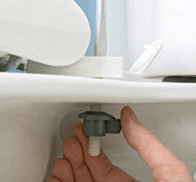
No matter how old the toilet is, the single most common problem we see are loose toilet seats. These days, the screws that hold toilet seats down tight are usually made of a thick plastic because when they were made of any kind of metal, they simply would not survive long and would corrode away. Almost all toilet seats just have two long plastic slotted screws under a little lid that can be easily tightened using a blade screwdriver. The screws typically have a nut underneath the porcelain that needs to be held from spinning while tightening the screws.
Water Keeps Running in the Toilet
This is also a very common problem that toilets have. After flushing, the toilet fills up, but then it doesn’t seem to shut off all the way, and water keeps trying to ‘fill’ the toilet. Usually, if that is happening, there are a couple of things that can be checked and fixed fairly easily…
(BEFORE attempting any repairs that affect the water to your toilet, be sure that you can control the water to the toilet, and turn off the water when working on any waterworks.
Check the Water Level in the Tank
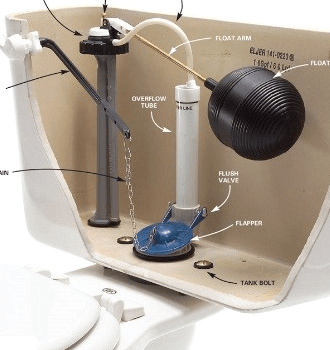
First of all, make sure the water level is proper, and the float is adjusted so that it shuts the water off below the top of the overflow tube. If the water level is too high, it will flow into the overflow tube, and the toilet will ‘keep running’. There is usually a line or mark on the overflow tube that indicates the correct water level. If you have an older style fill valve (ball-cock) with a float on an arm, you can carefully bend the arm to make the water shut off at the right level.
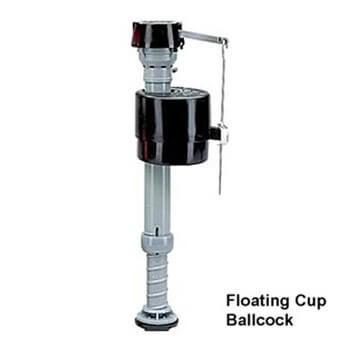
If you have the kind of fill valve that uses a vertical post and a floating cup, you need to spin the post as described in the manufacturer’s instructions to raise or lower the shut-off point for that fill valve.
Check the Flapper Seal
If the water level is okay but the toilet is still ‘running’, then the flapper in the bottom of the toilet tank is probably not sealing properly. There are many different types of flapper systems in use today.
You will need to lift the lid off the toilet tank and identify what kind of flapper your toilet has, and get a proper replacement if needed. To confirm if your flapper is leaking, put a little blue or red food coloring in your toilet tank and see if it migrates into the bowl after a few minutes without flushing.mIf it does, then the flapper that is supposed to hold all the water in the tank is not sealing properly and needs to be replaced.
Hopefully, the advice I’ve given will help you navigate some of the simpler toilet problems. You can also find many ‘how-to’ repair videos online. That said, don’t be surprised or discouraged if you try repeatedly to fix your own toilet and still need to call in a professional. Sometimes, it’s not as simple as it seems.
In our own apprenticeship course for service plumbers, we spend over 24 hours just on basic toilet repairs because there are so many different kinds of toilets and so many things that can go wrong. The truth is, as common as toilets are, they’re sometimes very tough to fix, and even the pros have to make multiple attempts to get it right.
Bruce Davis, Sr. is a Licensed Journeyman Plumber, Licensed Electrician, HVAC/R Electrical Administrator, HVAC/R professional, and Certified WA State C.E.U. Instructor. Day and Nite Plumbing and Heating, Inc. has been serving Snohomish and North King County for over 68 years, and Bruce Sr. has been President and working at this family-owned business for 36 years. Bruce can be contacted at: Email: Bruce@dayandnite.net Day and Nite Plumbing and Heating, Inc. 16614 13 Ave. W. Lynnwood, WA 98037, (800) 972-7000