

How Washington LLCs PROTECT Real Estate Investors (Only If You Use Them Correctly)

Washington real estate investors often form limited liability companies (LLCs) to hold rental properties, joint ventures, and development projects. A Washington LLC can create a legal separation between your investment activities and your personal assets when it is formed and operated correctly under RCW 25.15 (the Washington Limited Liability Company Act).
But creating the LLC is only the beginning. An LLC is just a name if you don’t run it as a separate business. Many investors assume that filing the formation documents automatically protects everything they own. In reality, the day-to-day operation of the LLC matters just as much as filing with the Secretary of State. The same is true when you own property with a partner: you need a clear operating agreement so everyone understands what happens if someone wants out, becomes disabled, or passes away.
This guide is for Washington real estate investors, small development groups, and families holding investment property. You’ll learn:
- how LLC liability protection works under Washington law
- when that protection can be lost
- why operating agreements matter in partnership deals
- practical steps for running your LLC properly
- why these issues are especially important now in Washington
Why LLCs Matter for Washington Real Estate Investors
What an LLC protects under Washington law
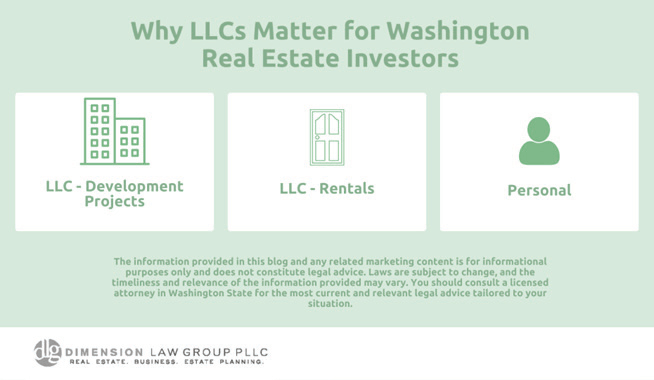
A limited liability company (LLC) is a separate legal entity created under RCW 25.15. If you form an LLC and operate it correctly:
- the LLC owns the property
- contracts and agreements are made in the LLC’s name
- liability for disputes is generally limited to the LLC’s assets
The core idea is that your personal assets are not automatically at risk if your LLC faces a lawsuit over a tenant injury, a construction dispute, or another real estate issue.
Washington law respects this separation when the LLC is treated like a real business — not as an extension of its owners.
When liability protection can be lost
Washington law also recognizes that there are circumstances where it is appropriate to hold LLC members personally responsible. Under RCW 25.15.061, courts may “pierce the veil” when the LLC is used as an alter ego of its members or to carry out wrongful conduct.
In practice, the risk increases when:
- business and personal funds are mixed
- the LLC has no internal records or documentation
- real property is titled in a member’s name instead of the LLC
- contracts are routinely signed personally, not on behalf of the LLC
- there is no written operating agreement
It’s important to understand that veil-piercing is not automatic just because a mistake happens. Washington courts look at the full factual picture:
- Are finances separated?
- Is property titled to the LLC?
- Are decisions documented?
- Does the LLC maintain required records?
Signing something personally can increase the risk that a court views you as personally obligated, but it is one factor among many — not a guaranteed loss of protection.
Why this matters in Washington real estate
Washington real estate is process-driven. Even small projects can involve:
- building permits
- land-use reviews
- environmental conditions
- city or county deadlines
- lender requirements
- tight refinancing timelines
If the member who knows the project best becomes unavailable (due to death, disability, or dispute), important deadlines can be missed. Once a permit expires or a project stalls, it can be difficult or costly to recover.
This is why entity structure, succession planning, and operating agreements are especially important for Washington investors.
The Operating Agreement: The Most Overlooked Tool in Washington Real Estate
Why handshake deals fall apart
Many investors in Washington start deals informally:
- two friends buying a duplex
- a small group converting a property
- family investing together
Everyone is aligned in the beginning, and it can feel awkward to talk about “what if something bad happens.” But years later, circumstances change:
- someone wants to sell
- a member moves away
- the market shifts
- a refinancing opportunity appears
- a member passes away
Without a written operating agreement, partners often find themselves building rules from scratch in the middle of conflict or grief.
What a strong operating agreement covers
A well-drafted operating agreement usually covers:
- ownership and contributions
- how ownership percentages are calculated
- how capital contributions are documented
- decision-making
- who can act for the llc
- what requires a vote and what requires unanimous consent
- exit strategy
- how a member can sell their interest
- whether the LLC or other members have a right of first refusal
- valuation
-
how the membership interest is valued if someone leaves
-
- death or incapacity
- whether heirs receive economic rights, voting rights, or both
- dispute resolution
- mediation or arbitration procedures
- deadlock rules
These are not theoretical issues. They are common events in multi-owner real estate.
Special considerations for Washington investors
Because Washington has city and county deadlines tied to land use, your operating agreement should also consider:
- who responds to building-department requests
- how decisions about ADUs or DADUs will be made
- how refinancing proceeds are allocated
- when profits are distributed versus retained
- whether a 1031 exchange requires unanimous consent
Well-written agreements protect relationships and investments.
Running Your Washington LLC Correctly (Not Just Filing the Paper)
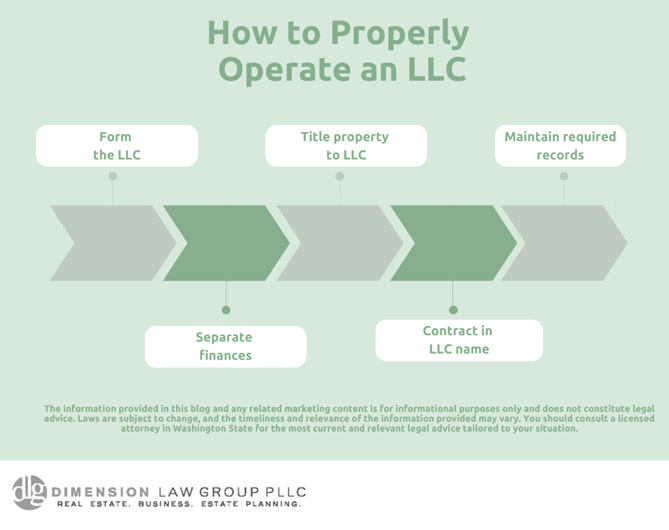
Forming an LLC is only the first step. To maintain liability protection, you must operate it like a separate business.
Separate assets and accounts
Good practices include:
- keep separate bank accounts
- record contributions and distributions
- maintain separate accounting records
- ensure income and expenses run through the LLC account
- avoid using the LLC to pay personal expenses
Real estate should be titled to the LLC, subject to any lender restrictions. Some lenders require consent before transferring title into an LLC, so it’s wise to review loan documents before retitling.
Contracting in the right name
Contracts related to the property should be in the LLC’s name, with the member signing in their official capacity. For example:
Evergreen Holdings LLC
By: Jane Doe, Managing Member
Signing personally increases the risk that someone later argues you accepted personal liability, especially if the LLC is not consistently treated as separate.
Internal records required by Washington law
Washington law requires LLCs to maintain certain internal records. Under RCW 25.15.136, a Washington LLC should keep at its principal office:
- the Certificate of Formation and amendments
- a list of members and their interests
- records of contributions and distributions
- copies of written consents or minutes
These records help prove that the LLC truly operates as a business.
In addition, Washington law often treats a charging order as the primary remedy for creditors of a member. While this protection does not cover all scenarios, it reflects the state’s preference to protect LLC assets from being taken directly to satisfy personal debts of a member — a protection that assumes the LLC is properly operated.
Why This Matters More Now in Washington
More co-investing and infill development
Changes in zoning and housing policy — including laws that encourage ADUs and small infill projects — have allowed more Washington residents to co-invest in real estate. With more people participating in one deal, the risk of unclear agreements grows, especially when tied to a permit or financing timeline.
Courts expect clean records
In disputes, courts look at whether the LLC is operated as a business:
- separate accounts
- proper titling
- record-keeping under RCW 25.15.136
- documented decisions
If the LLC is only a formality, limited liability may be harder to defend.
Estate tax changes increase planning needs

Washington has its own estate tax, separate from federal rules. As of 2025, the Washington estate-tax exemption is $3 million for certain decedents, with higher rates above that threshold.
Forming an LLC does not remove property from your taxable estate — the value of your membership interest is included in the calculation. The planning question becomes:
- how your interest passes at death
- whether heirs receive economic vs. voting rights
- how estate tax affects the project and the surviving partners
For real estate held through LLCs, estate planning and operating agreements should work together.
LLCs are powerful tools for Washington real estate investors
But the protection comes from how you use them, not just from filing the paperwork. To strengthen your position:
- Treat the LLC like a real business
- Use a clear operating agreement for multi-owner deals
- Separate accounts, records, and contracts
- Understand how Washington’s estate-tax rules affect ownership transfers
These steps do not guarantee any outcome, but they significantly improve the chances that your LLC will function the way you expect — and protect the investment when circumstances change.
Property owners who are forming a new LLC, buying with a partner, or revisiting their structure may benefit from a legal review to understand their current level of protection under Washington law.
Disclaimer
This article is for general informational purposes only and does not constitute legal advice. Reading this post does not create an attorney–client relationship. Laws and regulations change over time and vary by situation. Please consult a licensed Washington attorney for legal advice specific to your circumstances.
Julie Martiniello is a Co-Owner and Managing Partner at Dimension Law Group, where she focuses on Estate Planning, Probate, Real Estate, and Business Law, helping business owners, real estate investors, and families protect their assets and plan for the future. She may be contacted via julie@dimensionlaw.com. Visit their website dimensionlaw.com.