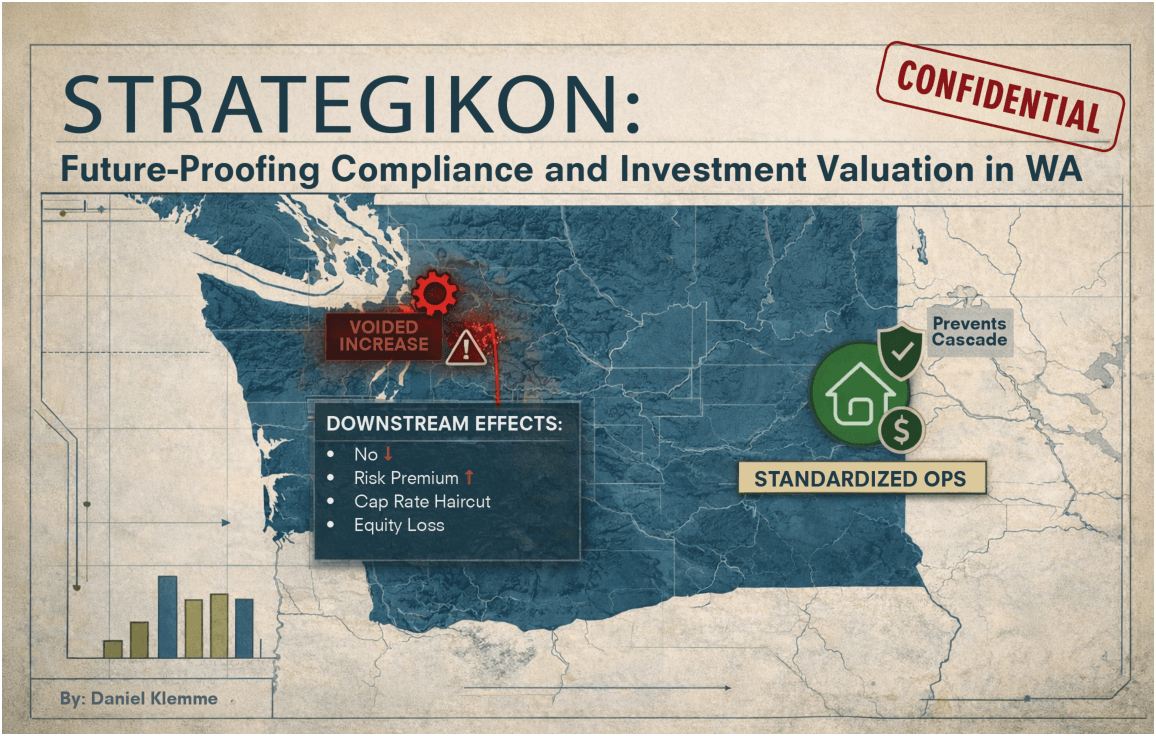
STRATEGIKON: Future-Proofing Compliance and Investment Valuation in WA
In the late 6th century, the Byzantine Emperor Maurice authored the Strategikon, a definitive manual on military science. Unlike heroic epics that focused on individual valor, the Strategikon was a work of cold pragmatism. It argued that victory was not a product of luck or brute strength, but of superior organization, standardized procedure, and the ability to adapt to a changing battlefield. It was the “secret sauce” that allowed a disciplined force to outmaneuver much larger, less organized adversaries.
For decades, Washington real estate investors have operated under the “Valor” model: buying the best locations, renovating with the best materials, and fighting for the highest rent. But in 2026, the battlefield has shifted from the physical property to the regulatory landscape.
The new “secret sauce” for the modern investor isn’t a better granite countertop; it is Strategic Compliance. Under the Strategikon Theory, the integrity of your paperwork is now a stronger predictor of Return on Investment (ROI) and Net Operating Income (NOI) than the quality of your real estate. In Washington, if your income cannot be lawfully adjusted, defended, or liquidated, it is not revenue—it is fiction.
I. THE STRATEGIC PIVOT: GAINING THE COMPETITIVE EDGE THROUGH PROCEDURE
The original Strategikon was designed to minimize “friction” and maximize “predictability.” In real estate, friction is represented by voided rent increases, improper notice service, and regulatory fines. While many investors still view paperwork as a clerical chore, the disciplined investor views it as a strategic asset.
By shifting your mindset, you move ahead of the competition. While others get bogged down in “Economic Vacancy”—units occupied by non-payers who cannot be evicted due to defective notices—you are scaling your business on a foundation of bulletproof documentation.
The Hierarchy of Vacancy
To understand value destruction, we must distinguish between two types of emptiness:
- Physical Vacancy:
A unit that is empty. This is a tactical nuisance—a temporary problem solved with a rent drop or marketing push - Economic Vacancy (The Compliance Trap):
A unit occupied by a non-paying tenant who cannot be removed because of a paperwork defect. This is a strategic catastrophe. It represents a 100% revenue loss, plus legal fees and potential statutory damages. Unlike physical vacancy, this state is indefinite.
II. THE MECHANICS OF VALUE DESTRUCTION: HOW PAPERWORK FAILURES ERASE EQUITY
In Washington’s “strict compliance” environment, paperwork failures mechanically destroy the two metrics lenders and buyers care about most: NOI and Cap Rate. Strict compliance means a judge looks only at the document, not your intent. If a mandatory disclosure is missing, the entire notice is a nullity.
1. The “Voided Increase” Tax
Under the Rent Stabilization Act of 2025 (HB 1217), rent increases are governed by precise caps and notice requirements. For 2026, the maximum allowable increase is 9.683%.
- The Reality:
Attempting any increase over the cap—or using the correct percentage on notices lacking required language, or serving the correct notice at the incorrect time—can make the entire increase void. - The Valuation Hit:
On a 20-unit building with a $200 increase, a voided notice results in a $48,000 annual NOI loss. At a 5% Cap Rate, that clerical error slashes property value by $960,000. Because the error is often systemic (the same form used for all units), the loss is binary: either you have the income, or you don’t.
2. The “Accidental” Month-to-Month (MTM) Conversion
Washington’s “Just Cause” eviction protections (RCW 59.18.650) have made the Fixed-Term Lease the most valuable document in an investor’s file.
-
The Strategic Consequence:
If renewal notices are served improperly (or not at all), the tenancy converts to MTM. MTM tenancies are “sticky.” In many jurisdictions, you cannot end them simply to renovate or sell. This freezes your ability to reposition the asset, effectively killing a “Value-Add” exit strategy. Your “renovation play” becomes a “litigation play.”
III. THE LENDER’S LENS: THE “ROCK” AND THE RATIO
The most sophisticated part of the Strategikon Theory involves financing. Institutional lenders do not lend on bricks; they lend on the certainty of cash flow. When you approach a lender, your compliance history directly impacts the capital stack.
The “Haircut” and the “Rock”
In real estate finance, the “Rock” refers to the cash equity required to close the deal. Compliance failures directly increase the size of the Rock you must carry.
- The Haircut:
If due diligence reveals your rent roll is legally vulnerable (e.g., increases over the cap, missing business licensing), lenders will “haircut” (discount) your underwritten income. They might verify $500,000 in revenue but only underwrite $400,000 because the other $100,000 is legally indefensible. - The Leverage Collapse:
Real estate is a leverage game. If your income is haircut by 20%, your Loan-to-Value (LTV) ratio drops. Instead of getting a loan for 75% of the purchase price, you might only qualify for 60%. - The Consequence:
You must now bring 40% cash to the table instead of 25%. This massive increase in required equity destroys your Cash-on-Cash return and limits your ability to buy other deals. You are “equity heavy” simply because your paperwork couldn’t support the debt.
Debt Yield and Risk Premiums
Lenders are beginning to tag properties with sloppy paperwork with a “Regulatory Risk Premium.” This manifests as higher interest rates and shorter amortization periods. When the paper is messy, the lender assumes they may eventually have to foreclose on an asset they cannot easily re-tenant. Bad paperwork literally raises your interest rate.
IV. THE UNLAWFUL DETAINER NIGHTMARE: A DIRECT ATTACK ON CASH FLOW
In Washington, eviction authority is procedural, not assumed. With the expansion of Right to Counsel, tenants have free legal representation trained to find “tactical technicalities.” If you lose an eviction case (Unlawful Detainer) due to a paperwork error, the financial blow is immediate:
-
Fee Shifting:
You may be ordered to pay the tenant’s legal fees, often $5,000 to $15,000. This is an immediate cash expense hitting your operating account. -
Statutory Damages:
You may be liable for triple damages if the court finds the notice was served in “bad faith” or violated the Consumer Protection Act, the RLTA, or local ordinances. -
Attorney General Exposure:
Since 2025, the AG has been actively fining landlords up to $7,500 per violation for rent cap non-compliance. For a 10-unit mistake, that is a $75,000 fine—enough to bankrupt many small investors.
V. THE “SECRET SAUCE”: SCALING VIA STANDARDIZATION
The true high-level secret to the Strategikon Theory is Standardization. You cannot scale a real estate business if every property has a different lease and every manager uses a different notice form.
Compliance as a Force Multiplier
Scale is achieved when you move from “Managing a Property” to “Operating a Portfolio.”
-
The Scaling Trap:
Most investors hit a “Complexity Wall”—the point where legal errors and administrative chaos consume all profit. Without standardized forms, every unit becomes a unique legal experiment. -
The Secret Sauce:
Using a standardized system (like RHAWA leases and forms) creates a Standardized Operating System. This gives you 100% confidence that every notice, if served correctly, is legally bulletproof. Standardization allows you to manage 100 units with the same mental effort it previously took to manage 10. -
Operational Velocity:
Standardized compliance reduces friction at turnover. When you know your move-out process is legally sound, you can turn units faster. When you know your screening criteria (RHAWA) are compliant with local “First-in-Time” laws, you can approve tenants instantly without fear of discrimination suits.
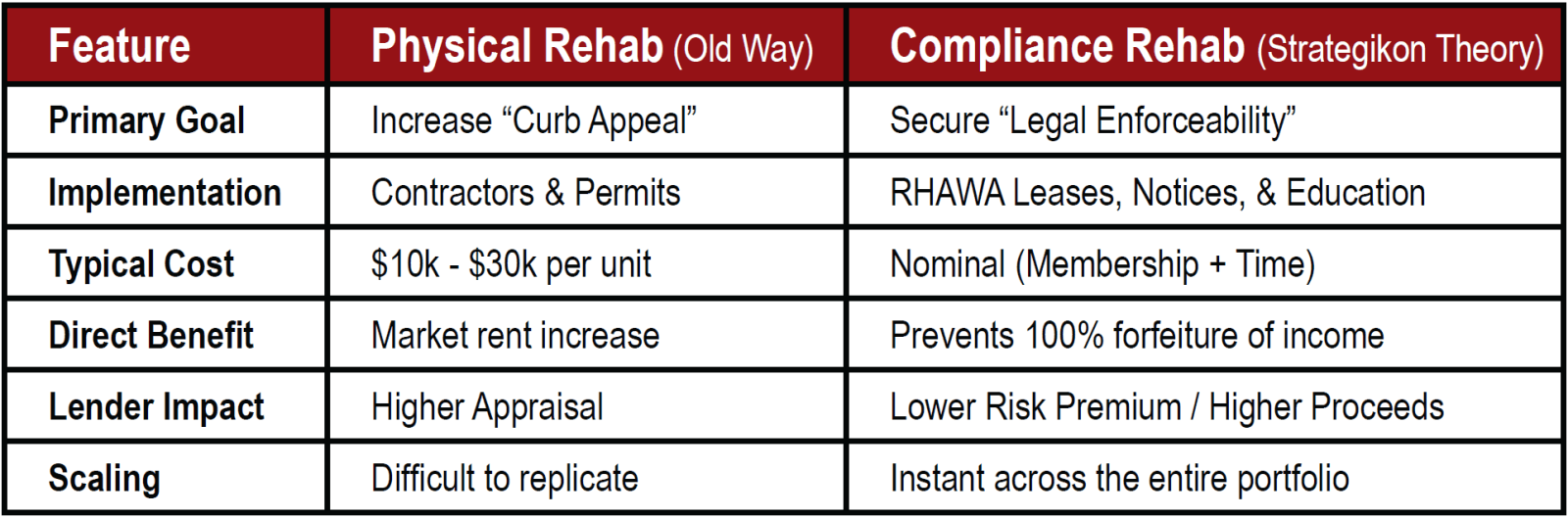
VI. THE NEW “VALUE-ADD”: PHYSICAL VS. COMPLIANCE REHAB
The industry is obsessed with Physical Rehabilitation. We spend millions on “Value-Add” strategies involving quartz countertops and LVP flooring. But for the sophisticated owner, Compliance Rehab is the ultimate impact driver. It is the “invisible renovation” that secures the asset’s floor.
VII. RHAWA: THE PROFESSIONAL ADVANTAGE AND STRATEGIC RESERVE
This is where the Rental Housing Association of Washington (RHAWA) shifts from being a vendor to a Strategic Partner. Membership, classes, and events are the armory of the modern strategist.
-
The Shield of Admissibility:
RHAWA forms are vetted by attorneys specifically for the 2026 Washington landscape. Using an internet template is like bringing a knife to a drone fight. -
Jurisdiction Awareness:
RHAWA provides specific addenda for jurisdictions statewide, preventing the “Daily Fine” traps where local registries charge for non-compliance. -
Intellectual Value-Add:
RHAWA classes and events provide the high-level tactical intelligence required to stay ahead of the curve. Understanding the nuance of the law (e.g., “Just Cause” vs. “Fixed Term”) is a value-add that never depreciates. -
Standardization for Exit:
Using RHAWA tools as your Operating System makes your business more attractive to institutional buyers. They aren’t just buying your building; they are buying your compliance track record. A clean file means a higher exit multiple.
VIII. CONCLUSION: THE PARADIGM SHIFT
It is time to update the industry’s definition of Deferred Maintenance.
Deferred maintenance is not just a leaky roof or a cracked driveway. Deferred maintenance is a 2021 lease in a 2026 legal environment. It is a rent increase served without a required disclosure.
It is a handshake deal with a long-term tenant that has no written fixed term.
The Strategikon Theory suggests that we must stop viewing paperwork as “admin.” In Washington, the paper is the property. If you manage the paper with the same discipline you apply to your capital, the value will follow. If you neglect it, no amount of market appreciation or granite countertops can save your equity from a compliance shock that erases your life’s work.
Compliance Rehab is the most profitable renovation you will ever perform, and RHAWA forms and education are your number one way to future-proof your investment, defend your valuation, and scale your business to the next level.