Partnering with Community Resources

If you’ve been in the rental housing business for any length of time, you know that success isn’t just about screening well and collecting rent on time. Increasingly, it’s about understanding how to work within a larger ecosystem — one that includes your membership with RHAWA, working with housing authorities & nonprofit service providers, and understanding the legal protections that shape how we operate in Washington State.
For many housing providers, “working with programs” can feel complicated or even risky. But when done correctly, these partnerships can stabilize income, reduce vacancy loss, and help residents succeed long term. Let’s walk through what that really looks like in practice.
First: Source of Income Is Protected
Before discussing specific programs, it’s critical to understand the legal foundation.
Under RCW 59.18.255, “source of income” is a protected class in Washington. That means you cannot deny an applicant simply because they use rental assistance, Social Security, VA benefits, disability income, unemployment benefits, or any other lawful, verifiable source of income.
Applicants must provide documentation verifying the source and amount of income, but once verified, it must be considered just like employment income.
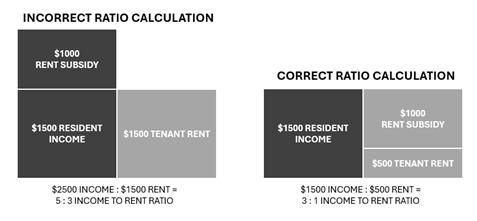
One area where housing providers commonly make mistakes is income qualification. The law requires that when evaluating income-to-rent ratios for subsidized tenants, you subtract the voucher amount from the rent before applying your ratio — rather than adding the subsidy to the tenant’s income.
For example, if rent is $1,500 and the subsidy covers $1,000, the tenant’s obligation is $500. If you require income equal to three times the rent, you apply that standard to the $500 tenant portion — not the full $1,500. That shift in logic often makes the difference between denial and approval.
In Seattle, there is an additional requirement: landlords must accept a written pledge of payment from a subsidy provider within five days in response to a pay-or-vacate notice.
Understanding these rules protects you from liability and positions you to use these programs effectively.
Working with the Housing Authority (Section 8)
The most commonly encountered subsidy program is the federal Housing Choice Voucher Program, often referred to as Section 8, administered locally by regional housing authorities.
At its core, the program provides a rental subsidy based on the tenant’s income. The housing authority pays its portion directly to you each month. If the tenant’s income drops, the housing authority may increase its portion so that you continue receiving the full contract rent.
From a landlord’s perspective, that stability is significant.
You still use your own lease and screening process. Federal programs have already conducted criminal background checks on adult household members, but you screen the voucher holder just as you would any other applicant. Once approved, you complete a Request for Tenancy Approval, the unit passes inspection, and both the lease and Housing Assistance Payment (HAP) contract are executed.
Yes, there is paperwork and an inspection process. Also, any term changes or other notices you serve on the tenant must also be copied to your housing authority representative. But in exchange, you receive contracted monthly payments and a housing specialist assigned to the case. In many situations, professional support can help resolve problems before they escalate.
Risk Mitigation: Washington’s Safety Net for Housing Providers
A major concern among rental owners is risk: What happens if there’s damage? What if the tenant defaults?
Washington addresses this through the state’s Landlord Damage Relief Program, administered by the Department of Commerce. This program provides financial mitigation to landlords who rent to tenants using housing subsidies.
The program can reimburse move-in upgrades required to pass inspection (up to $1,000), cover up to 14 days of rent loss, and provide up to $5,000 for certain qualifying damages beyond normal wear and tear, unpaid rent, late charges, legal expenses, and some utility charges.
Applying requires documentation: a signed lease, inspection reports, move-in condition reports, proof of subsidy payments, before-and-after photos, and repair invoices. But for many housing providers, knowing this safety net exists changes the risk calculation significantly.
A Different Model: Housing Connector
Another organization that many Washington landlords encounter is Housing Connector.
Housing Connector acts as a bridge between private property owners and individuals facing barriers to housing. Instead of working with multiple agencies, you work through a single point of contact.
Their model includes free referrals for vacant units, risk mitigation funds up to $5,000, a three-month rent guarantee, one month of vacancy loss coverage, and up to two years of housing stability support for residents. In exchange, housing providers agree to adjust or reduce certain screening barriers to expand access.
For some owners, this partnership provides both financial protection and operational support — particularly when renting to higher-need households.
When Tenants Face a Crisis
Not every situation involves a formal subsidy program. Sometimes, a stable tenant simply experiences a temporary crisis — job loss, medical emergency, unexpected expense.
In those moments, communication is your most powerful tool.
Start with a conversation. Understand what’s happening. Explore payment plans or temporary adjustments. Encourage the tenant to contact utility providers for low-income discounts if applicable.
Washington has a strong network of community-based support organizations. Housing authorities, Veterans Affairs Supportive Housing (VASH), Catholic Housing Services, Salvation Army, St. Vincent de Paul, Helping Hand House, and many others may be able to assist.
There is also 211, a statewide referral network that connects individuals to food banks, clothing resources, mental health services, and other supports that can stabilize a household before housing is lost.
When you maintain awareness of these resources, you’re better equipped to guide residents toward solutions rather than immediately toward vacancy.
Why This Matters for Your Business
At first glance, partnering with community resources may feel like extra work. There are forms to complete, inspections to schedule, and relationships to manage.
But step back and look at the broader picture.
Guaranteed or partially guaranteed rent reduces income volatility. Mitigation funds reduce damage risk. Case management services can support tenants in ways that landlords are neither trained nor positioned to provide. Vacancy loss protections shorten downtime.
Beyond the numbers, there’s reputational value. Housing providers who are known for professionalism and fair treatment build stronger relationships with agencies, advocacy groups, and residents alike.
And in Washington’s regulatory environment, understanding and cooperating with assistance programs isn’t optional — it’s part of operating compliantly and competitively.
The Bigger Perspective
Rental housing today operates within a larger community framework. Tenants are often connected to support systems, public benefits, and nonprofit organizations designed to promote stability.
Housing providers who understand that framework — and learn how to work within it — often experience fewer surprises, faster resolutions during crises, and more consistent long-term occupancy.
Partnering with community resources isn’t about charity. It’s about smart risk management, legal compliance, and sustainable operations.
For Washington housing providers, that combination can make all the difference between reactive property management and strategic rental business ownership.
Register for Class to Learn More
Our 12-part Property Management class series is now about halfway through. If you have not been attending so far, you can still sign up for individual classes. Partnering with Community Resources is scheduled on Thursday, April 23, from 12–1pm featuring instructor Kathryn Shabalov along with special guest Rebekah Strobel from Housing Connector. Check out our Calendar at RHAwa.org/events/ to register for this session, or any other class or event.
Formal legal advice and review is recommended prior to selection and use of this information. RHAWA does not represent your selection or execution of this information as appropriate for your specific circumstance. The material contained and represented herein, although obtained from reliable sources, is not considered legal advice or to be used as a substitution for legal counsel.