
Reasonable Accommodations for DISABILITIES

Under the Fair Housing Act and Washington State law, residential tenants with disabilities have the
right to reasonable accommodations or modifications. Common disability accommodation requests include Service and Emotional Support Animals, additional occupants for care-giving, reserved parking, or transfers. Modification requests include permission to install wheelchair ramps, handrails, and other physical changes to the rental property. These types of modifications are generally done at the tenant's expense.
Failure to process requests appropriately is the cause for over 50% of all fair housing complaints, and most of these are regarding assistance animals. A fair housing complaint can result in thousands of dollars in fines, attorney fees, and other costs.
If the disability or need for the accommodation is not obvious, the housing provider can request a letter from their licensed care provider (doctor, therapist, clergy, etc.) stating that the tenant is disabled and needs the specific animal or other accommodation due to their disability. The housing provider can request specific documentation for each animal or other accommodation requested, but only if the need is not obvious.
If a request results in an unreasonable financial or administrative burden or would change the nature of the housing provider’s business, they must work with the tenant to find a reasonable alternative solution. If at any time a tenant requests an accommodation and it becomes challenging to find a mutually acceptable solution, consider consulting an attorney before denying the request.
Processing Accommodation Requests
When processing an accommodation or modification request from a tenant with a disability, the housing provider can take steps to confirm that A) there is a disability-related need; and B) the request is reasonable. Remember, requests for assistance animals should be handled in this same manner.
Test A: Is there a disability-related need that would be met by the requested accommodation?
-
Is the disability and need for accommodation apparent/obvious or already known?
If NO, continue to the next step. If YES, skip to Test B. -
Can they provide a letter from a care provider?
The letter from a qualified third party must state that they have a disability and that they have a disability-related need for the specific accommodation requested. (Do not ask about the nature of the disability.)
If NO, you may deny the request. If YES, continue to Test B.
Test B: The request must be “reasonable.”
-
Do any of the following grounds for denial exist?
• It would impose a significant, undue financial and administrative burden.
• It would fundamentally alter the nature of the housing provider’s services.
• It would pose a direct threat to the health or safety of others.
• It would cause substantial physical damage to the property.If NO, you must grant the request. If YES, continue to the next step.
-
Is there an alternative reasonable accommodation that would meet the requester’s disability-related needs?
Following an interactive (documented) process, work with the requester to determine if there is an alternative accommodation that would effectively address their disability-related needs. If you are unable to agree on a reasonable solution, consult with your attorney.
If you are unable to agree on a reasonable solution, consult with your attorney.
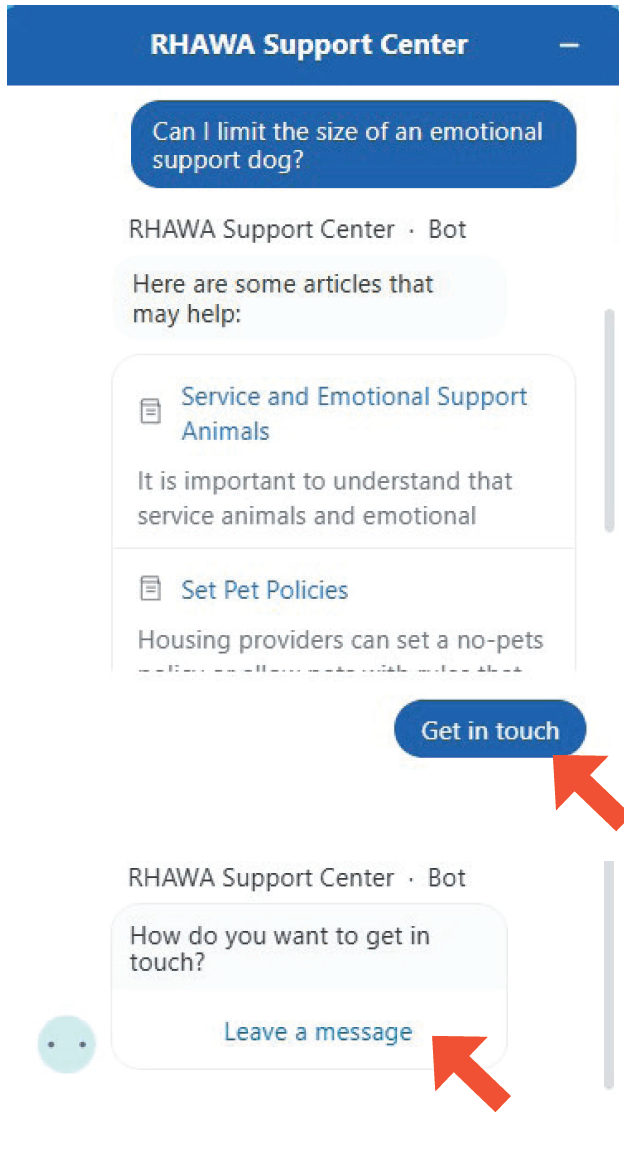
This article and many more are found in the RHAWA Support Center. Go to rhawa.org, and from Member Access, select Support Center. If you are unable to find an article that answers your question, leave a message for us there, and we will get back to you within one business day.
Formal legal advice and review is recommended prior to selection and use of this information. RHAWA does not represent your selection or execution of this information as appropriate for your specific circumstance. The material contained and represented herein, although obtained from reliable sources, is not considered legal advice or to be used as a substitution for legal counsel.