
Rental Codes In Tacoma Are Still A Tangled Mess
After living with the resulting confusion of two different rental codes in Tacoma, on top of major state law changes for the last two years, we were hopeful that the city’s Ordinance 29086, passed on December 9, would streamline things a bit more than it did, but several improvements have been made. We’ve updated our detailed law summary in the Support Center and our class on Tacoma Rental Laws. This article just hits the highlights, so make sure you check out the newly updated Tacoma law class ONDEMAND and review the Support Center article as well.
All changes from Ordinance 29086 are described and highlighted in italics.
There are still two separate rental codes found under Tacoma Municipal Code (TMC) 1.95 for the “Rental Housing Code” created by the city council, and TMC 1.100 covering the Landlord Fairness Code Initiative created by the voters’ initiative in 2024.
They are still enforced differently as follows:
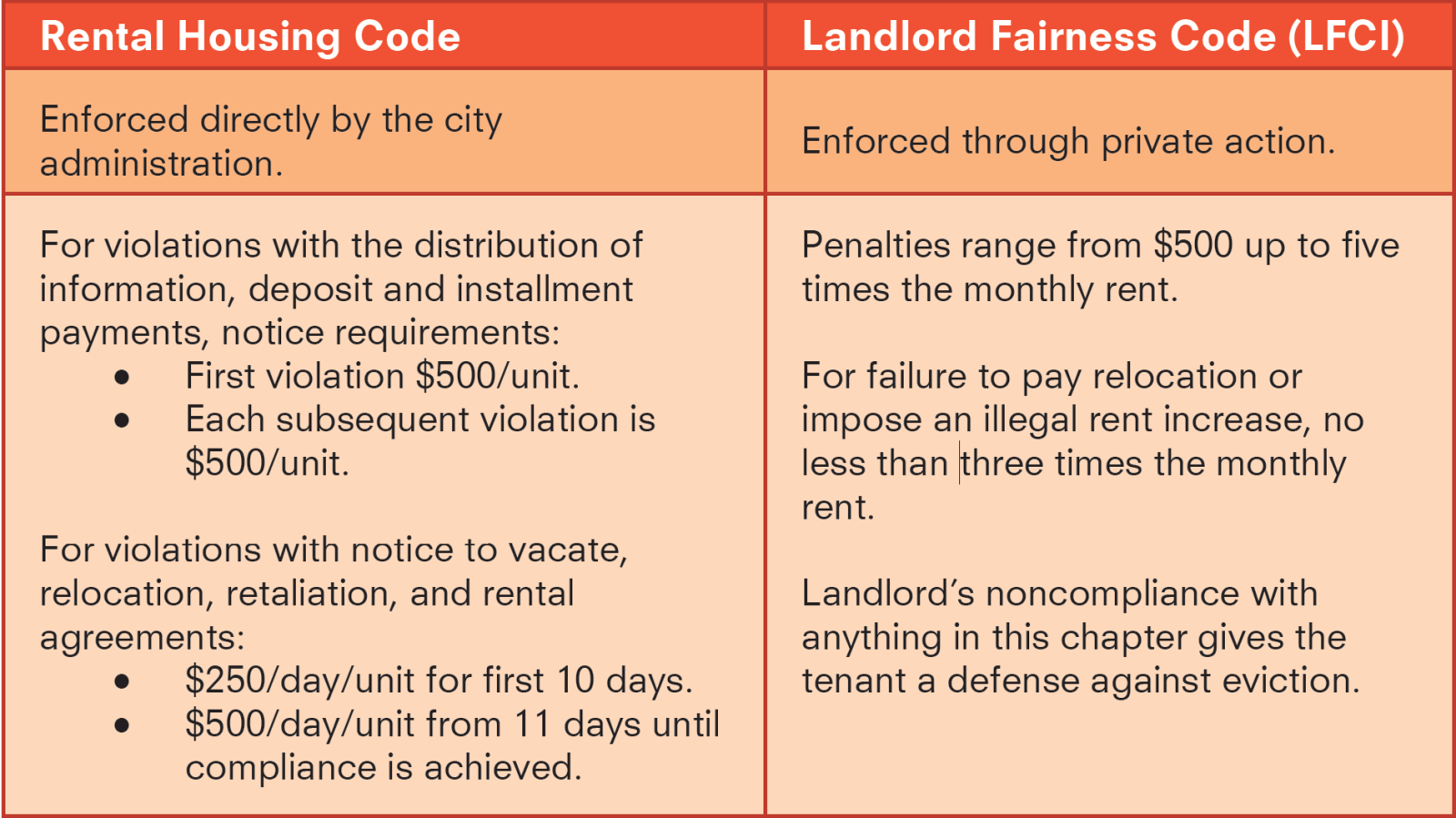
Throughout the law summary in the Support Center, (LFCI) indicates parts of the law that are enforced differently under the Landlord Fairness Code Initiative. All other parts are enforced by the City of Tacoma based on submitted complaints.
New guidance has been added on how to consider whether the LFCI creates an undue and significant economic hardship for landlords, allowing an eviction or exemption from an LFCI provision.
While the previous version of the code included exemptions for certain sections, like the seasonal eviction restrictions, there is now a new exemption section in the LFCI.
A new exemption section from all provisions of the LFCI has been added, covering various types of not-for-profit entities and deed-restricted housing providers, and these have been defined in the definitions section of the code.
Information for Tenants Requirements
One area that is particularly onerous in Tacoma law is the city-provided resources and forms that must be distributed by housing providers. While the Rent Increase Notice process has been streamlined, these notice requirements are still complicated. Following is a summary of the revised “information” requirements:
Written rental criteria and other information must be provided to all applicants, including:
- That tenant has the right to pay move-in costs (fees, deposits, last month's rent) in installments.
- City of Tacoma Tenant Resources webpage that provides information on properties and landlords:
◦ cityoftacoma.org/cms/one.aspx?pageId=167941
◦ Or, if the prospect cannot access online information, provide a hard copy of your property info found at tacomaopendata-tacoma.hub.arcgis.com - That social security number will be requested but not required.
- How criminal history will be assessed under the new Tacoma law.
- Minimum income requirements in compliance with the new Tacoma law (details below).
Several required tenant disclosures are provided by the City of Tacoma and can be downloaded from their webpage, Renting in Tacoma, under Landlord Resources:
- Landlords must provide the Renting in Tacoma Guide to the tenant or prospective tenant when offering a lease as a hard copy with a receipt signed by the tenant. Landlords must also distribute it at renewal and upon revision by the City (electronic copy is OK) and with any notice to a tenant under RCW 59.12.030.
- A form tenants can use to request a payment plan for move-in costs. Landlords must distribute this form to the prospective tenant or tenant when offering a lease.
- A required Tacoma rent increase form is also found here (the WA State-mandated Rent Increase Notice form must also be used to serve a rent increase notice).
- Specific information documents must be provided to tenants when serving the following notices:
◦ Rent increases
◦ Termination of tenancy
◦ Comply or vacate
◦ Pay or vacate
◦ Quit for waste, nuisance, or unlawful business
The LFCI and RHC were both changed so that now only one form (rather than three) is provided by the city. The “Notice of Resources” for Rent Increase has been revised to explain the rules under city and state laws. The Renting in Tacoma Guide will be revised with an “update sheet.”
Notice to Increase Rent Process (Tacoma and State Law)
- City of Tacoma requires 180 days’ notice before the effective date. (LFCI)
- Two notice forms must be served together:
◦ City of Tacoma 180-Day Notice of Rent Increase – RHC (found under Renting in Tacoma, Landlord Resources)
◦ WA State statutory rent increase form provided by RHAWA under Tenant Notices - The notices must be served in accordance with RCW 59.12.040.
- With the notice, the landlord must provide a copy of the resource summary prepared by the city for rent increases and information about relocation assistance:
◦ Notice of Rent Increase (found under Renting in Tacoma, Landlord Resources)
NOTE: Prior to serving notice, the landlord and rental property must be in compliance with:
◦ City business license requirements (TMC 6B) before landlord may serve notice
◦ All Tacoma tenant protection laws (LFCI)
◦ Tacoma tenant health and safety laws under TMC 2.01.050, and dwelling habitability laws under RCW 59.18.060 (LFCI)
Economic Relocation Assistance (LFCI)
-
Anytime after receiving an initial rent increase notice of 5% or more, a tenant deciding to relocate may send the landlord a request for relocation assistance. All tenants have the same right to assistance without regard to income level.
-
Within 30 days of receiving such a request, landlords must pay the relocation assistance to the tenant. Calculate per table (below) based on the rent in effect at the time of the initial notice. Payment is per dwelling unit, not per person. Payment is split evenly among all the tenants.
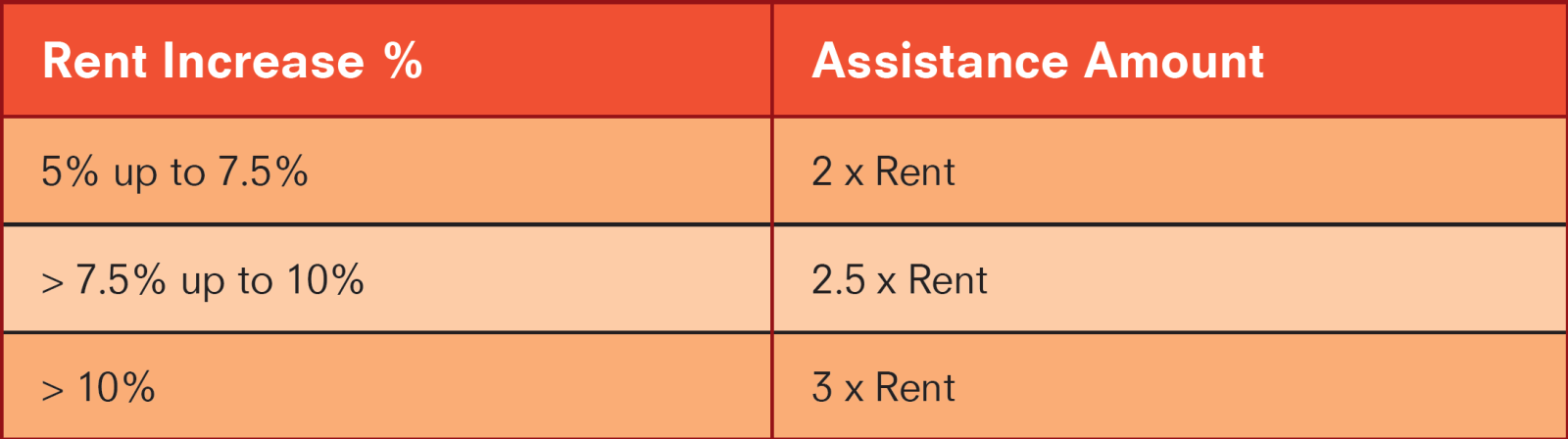
NOTE: This scale is adopted in recognition of additional time required to find replacement housing when a tenant’s current rent is below market rate.
-
Per the voter initiative, the landlord must provide a copy of the request and confirmation of payment to a city-designated official. However, the city may not have funds to enable this, and enforcement is only by civil lawsuit.
-
If the tenant is unable to relocate and remains in the dwelling unit at the increased rent, the tenant must repay the relocation assistance.
EXEMPTIONS: The requirement to pay tenant relocation assistance will not apply to:
• A landlord and tenant living on the same site if the site has four or fewer dwelling units
• Tenants who have lived in the dwelling unit for less than six months
• A landlord who temporarily rents out the landlord’s principal residence during the landlord’s absence due to active-duty military service
Late Rent Fee Cap
- Late rent fees are limited to 1.5% of rent per unpaid month of rent (LFCI and RHC).
- No other charges for late rent are permitted, including notice service or legal costs.
- A landlord must provide the tenant with written notice outlining late fees and how to come into compliance at least once per quarter.
- Notice of late fees must include detailed information on all that is owed.
- No late fees on non-rent charges are permitted.
- No late fees may be charged or paid after the end of tenancy (LFCI).
Previously conflicting late fee caps of $75 (RHC) and $10 (LFCI) were both eliminated. The revised code simply limits fees to 1.5% of unpaid rent.
Notice to Terminate Tenancy
Tacoma law on terminating tenancies is mostly the same as WA State law (RCW 59.18.650).
- All notices must include the stated reason for or condition(s) justifying the termination of tenancy.
- Prior to serving notice, the landlord and rental property must be in compliance with:
◦ City business license requirements (TMC 6B) before landlord may serve notice
◦ All Tacoma tenant protection laws (LFCI)
◦ Tacoma tenant health and safety laws under TMC 2.01.050, and dwelling habitability laws under RCW 59.18.060. There is a defense against eviction that the landlord is, at the time of eviction, in violation of tenant protection laws related to health and safety (LFCI).
Updated to include requirements when the owner elects to sell the rental property as outlined in RCW 59.18.650(2)(e).
Seasonal Eviction Restrictions (LFCI)
Tenants will have a defense to an eviction that:
- Requires the tenant to vacate during the school year (first day of the academic year to the last day of the academic year, as set by Tacoma Public Schools), and the tenant or any resident is:
◦ A child or student: any person under the age of 18 or currently enrolled in a school
◦ A person having legal custody of a child or student, such as a parent, step-parent, adoptive parent, guardian, foster parent, or custodian
◦ An educator: any person who works at a school as an employee or independent contractor, including teachers, substitutes, paraprofessionals, administrators, counselors, social workers, psychologists, nurses, custodians, cafeteria workers, and maintenance workers - Requires the tenant to vacate between November 15 and March 15
◦ Housing providers with four or fewer units are exempt from this provision
EXCEPTIONS: This eviction defense will not apply if the reason for termination is due to:
- Owner or family occupying the unit
- Condemnation or uninhabitability of the dwelling unit
- Desire for landlord’s roommate to vacate
- Sexual harassment by a tenant
- Tenant’s failure to comply with a three-day or ten-day notice to vacate for drug-related activity or nuisance
- Maintenance of an unlawful business
- Tenant conduct that has a substantial detrimental impact on, or constitutes an imminent threat to, the health or safety of other tenants or the owner
Several changes were made to this section.
It was split into two sections: Student School Year (1.100.060) and Cold Weather (1.100.063).
Prohibits cold-weather evictions are prohibited from November 15 through March 15, with an exemption for owners who own four or fewer rental properties in the Tacoma city limits.
New exceptions section was added for both school year and cold weather, with three additional cases: (1) owner selling the unit; (2) landlord selling the rental property; and (3) owner seeking to terminate tenancy where an ADU or home is rented on owner-occupied property.